

Gusty winds tease common milkweed seeds from their pods.
Its beauty isn’t on the outside. Common milkweed (Asclepias Syriaca), despite its attractiveness to monarch butterflies, isn’t the showiest of plants. Its large, smooth leaves and warty pods lack the delicacy of many native plants. Milkweed’s beauty is hidden within its pods.

Tiny green pods arise from fertilized pink, aromatic flowers.
Over the summer, small, perfumed pink flowers are fertilized and form tiny green pods or follicles. As they ripen, they grow to three-to-five inches in length. Inside, oval-shaped flat, brown seeds tethered to white, satiny strands designed for wind dispersal are arranged around a central column. Each is neatly tucked into a crevice on a membrane attached to the top and bottom of the pod.

Oval-shaped seeds attached to satiny strands are neatly arranged around a central column.
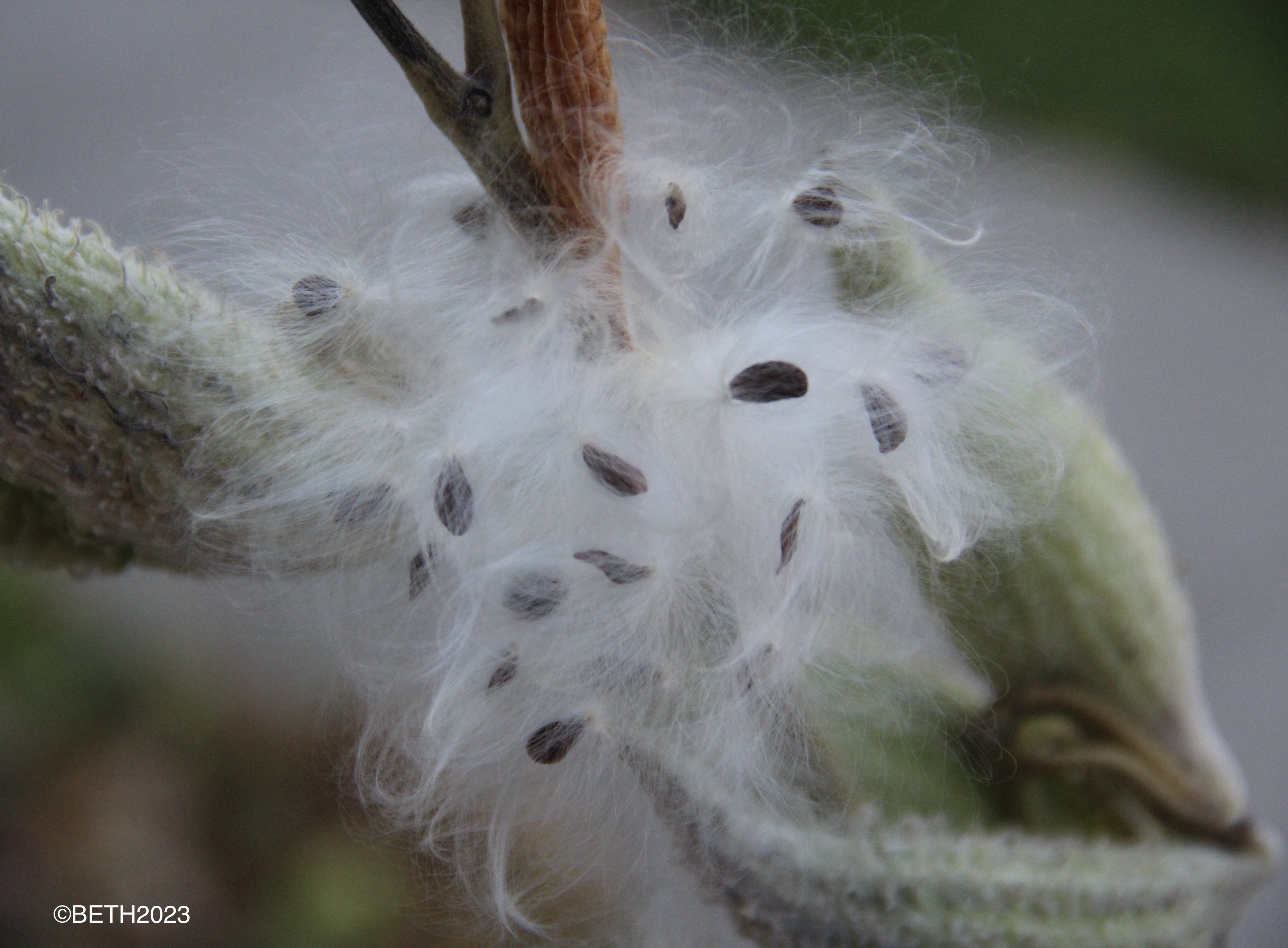
Wind fluffs the silky fibers into parachutes to disperse the seeds.
When the seeds mature, the pods dry and crack open. As wind enters the split pods, the silky strands unfurl and balloon into parachutes. One by one the seeds spin out of the pod like shimmering wind-borne dancers that glow in the autumn sunlight. I love to watch them sail — sometimes floating on a gentle breeze, sometimes scurrying on gusty winds. The empty pod is pretty too: Cream-to-gold colored and smooth inside, except for the center membrane, which is grooved to anchor individual seeds.

The empty pod is satiny smooth except for the grooved central column where the seeds were attached.
These lovely seeds used to be rare in Twin Cities urban areas, but now many residents grow one or more of 14 native milkweed species in their yard and boulevard gardens to attract monarchs and other butterflies.¹
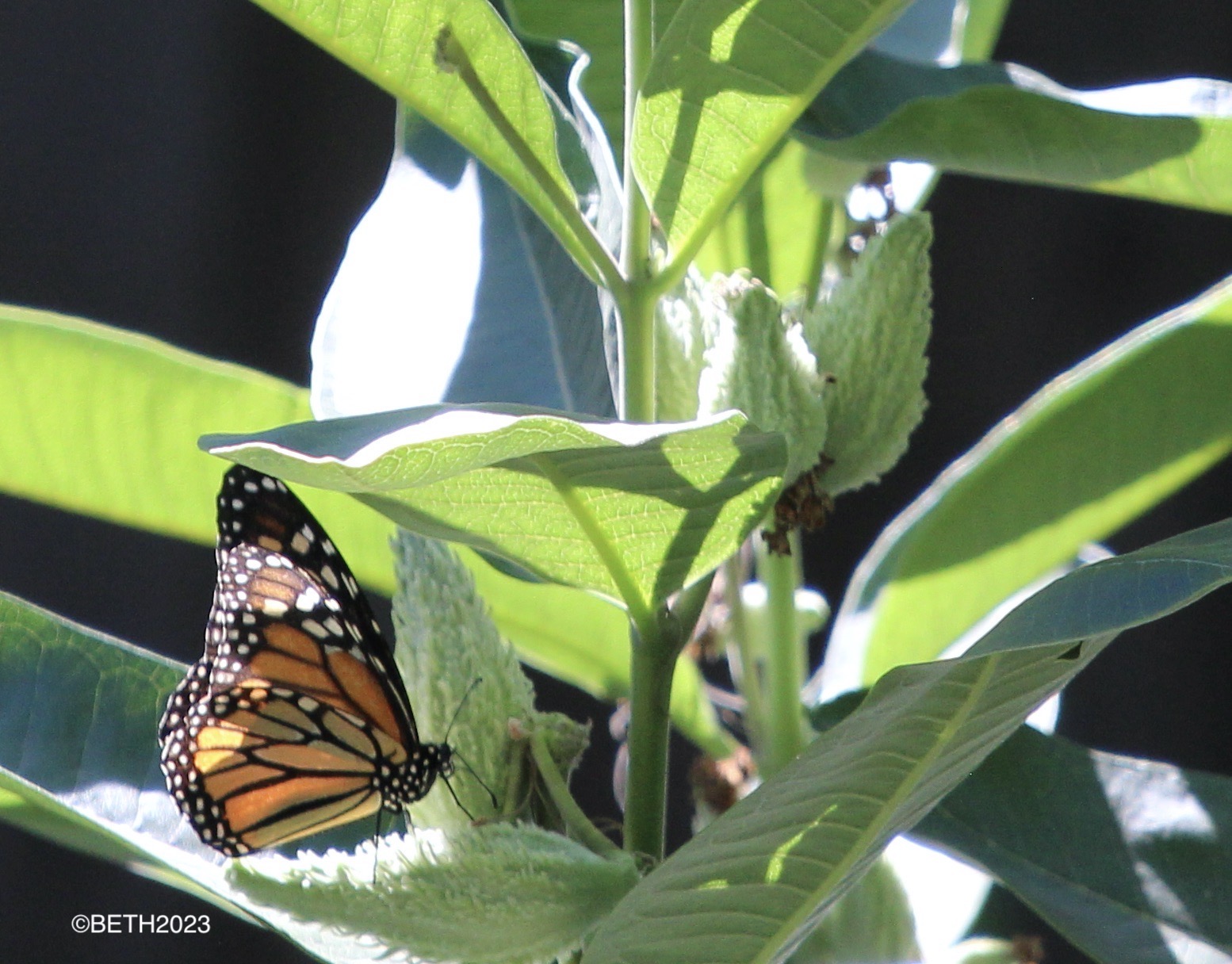
Milkweed plants are the sole host plant for monarch butterflies.
¹When handling milkweed, it’s best to wear gloves and eye protection. The plant’s milky latex sap can cause eye and skin irritation on contact. According to several sources, the sap is slightly toxic to humans if eaten in large amounts. Animals are also affected by it, but most avoid the plant. This substance helps to make monarch butterfly caterpillars unpalatable to birds.
Sources and Further Reading
Eloise Butler Wildflower Garden Common Name Plant List
Milkweeds of Iowa and Minnesota (Xerxes.org)
Minnesota Milkweeds for Monarchs
 Nature, Garden, Life
Hi Beth. I’m a little behind on my reading right now but I just wanted to tell you how much I enjoy your pieces!
Thank you, Linda! I always enjoy hearing from you and am delighted that you’re reading my blog!