
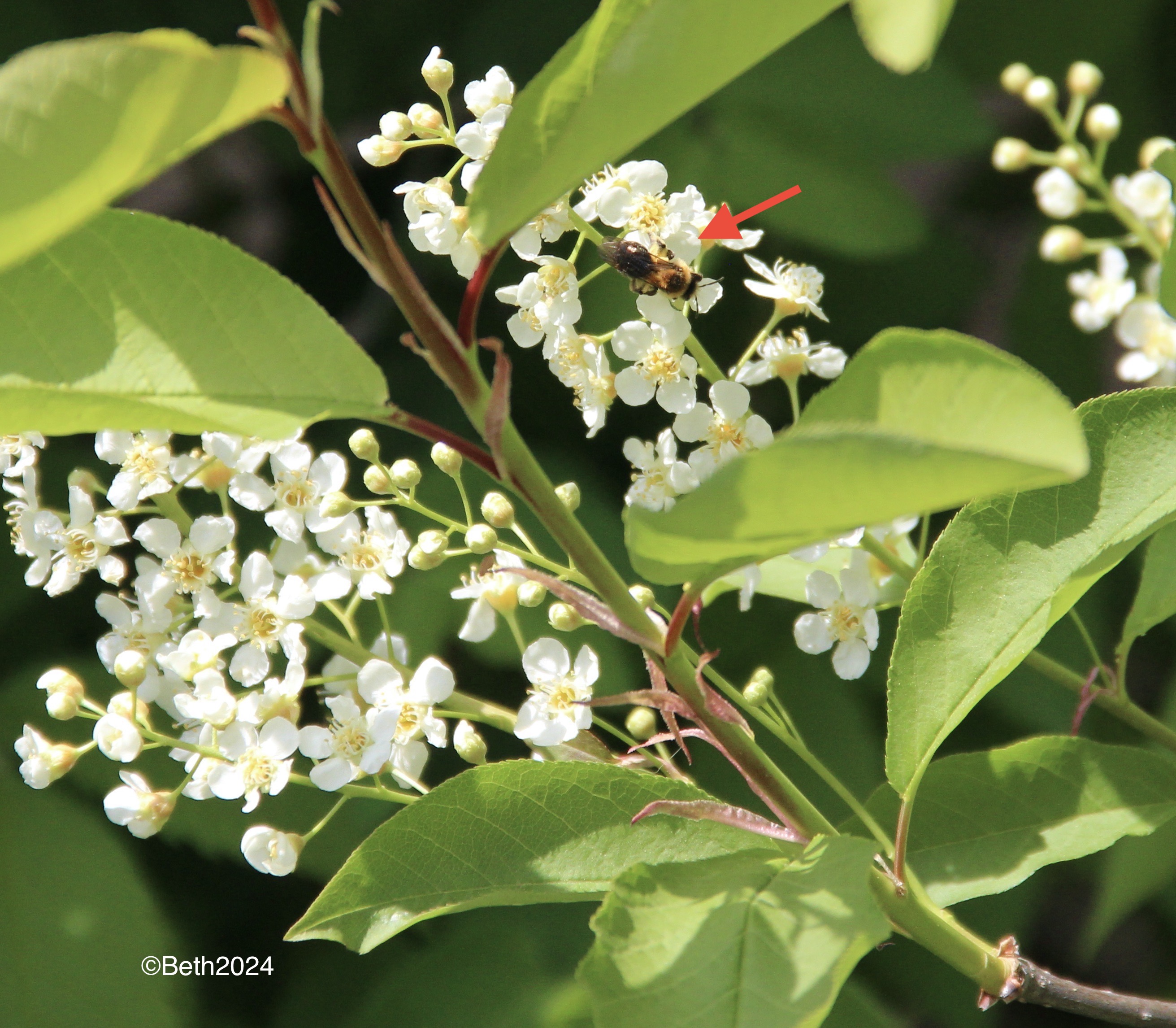
A mining bee (Andrena spp.) pollinates Canada cherry blossoms (Prunus virginiana, ‘Canada Red’).
Redbud, crabapple, dogwood, wild plum and cherry are just a few of the trees blooming in May. What’s pollinating all these beautiful blossoms?
More than 500 species of native bees are responsible for pollinating many of Minnesota’s spring flowers and trees. Mining bees (Andrena spp.) are one of the earliest to emerge and get busy. Like bumblebees, they are wrapped in warm, fuzzy hair that helps insulate and equip them to be active when it’s still too cold for honey bees to work.
Mining bees are solitary ground nesters. Unlike honey bees, bumblebees and others that nest in a colony, each mining bee digs her own individual spot, though they often nest near each other. Look for their small burrows, (about the diameter of an average pencil), in an exposed area of ground. I’ve seen them in soil along garden walls, in bare ground in the garden, or bordering sidewalks. The nests are only active for a very short time in spring and are interesting to watch. Female mining bees place small balls of pollen and nectar in their tunnels, lay an egg on top of each ball and then seal the chamber. Each larva will feed on the pollen and nectar during its development. The female dies soon after reproducing, while the larvae overwinter in their tunnels, typically leaving the following April or May to mate and continue the life cycle.

A mining bee (Andrena spp.) is dusted with pollen after working inside a Siberian squill (Scilla siberica) blossom.
Other species of mining bees reach adulthood in late summer and fall. Their life cycle is similar to their springtime cousins’, but they pollinate a range of different flowers, such as goldenrod and wild asters.
Sometimes people want to oust mining bees for fear of being stung, or they dislike the appearance of tiny tunnels in their garden or lawn. Unlike hornets and wasps, these small bees are quite docile and rarely sting unless handled roughly. They’re focused on producing the next generation and aren’t interested in sampling your supper or glass of wine! (In fact, most of the bees zipping around the nesting area are males, who don’t have stingers.) When I notice their nests, I just work around them and the bees ignore me. They’re more active when the sun warms their nesting area, so it’s easier to garden near them when it is shady and cool.
Besides pollinating flowers and fruit trees across North America, mining bees are prey for many songbirds, small rodents, jumping spiders, some species of ants and other insects.
Further Reading and Sources



 Nature, Garden, Life