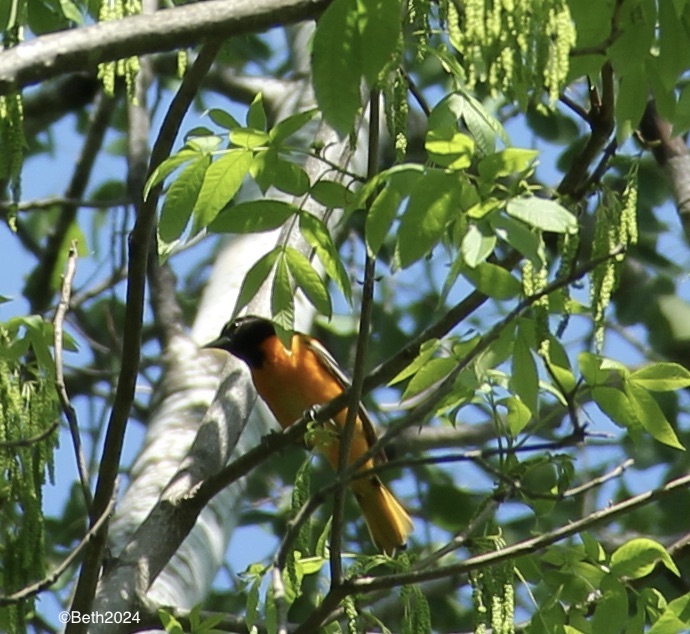
Baltimore orioles were named for the orange and black colors on the heraldic crest of the Baltimore family of England, for which the City of Baltimore, MD, is also named.
Like miniature suns, Baltimore orioles (Icterus galbula) light up early summer’s lush green foliage. About the size of a red-winged blackbird, these orioles are colorful members of the blackbird family. They are often recognized for their golden color and beautiful woven hanging-basket nests.¹
I saw my first Baltimore oriole in the Twin Cities when I was five or six. Graceful American elms lined every street then, and were the preferred nesting tree of orioles. Since the demise of the elms by Dutch elm disease, many of the orioles I see and hear are in the woods at our cabin. In the city, I find them most often when I walk next to the Mississippi River and around the Minneapolis lakes. Their call is described as paired, pure flutelike notes. They’re easy to listen to and their song contains fewer harsh notes than other oriole species.
Most years, they weave a nest in the outer branches of quaking aspens that overhang our cabin yard, but one year, they nested in a red oak tree next to the cabin. The female constructs the nest using a combination of plant fibers, such as long strips of bark from grape and other vines, grasses and hair. She often selects artificial fibers, too — yarn, fishing line and twine. The two outer layers of the nest provide the saclike structure. The third inner layer consists of soft hair, wool and downy fibers to protect the eggs and hatchlings.
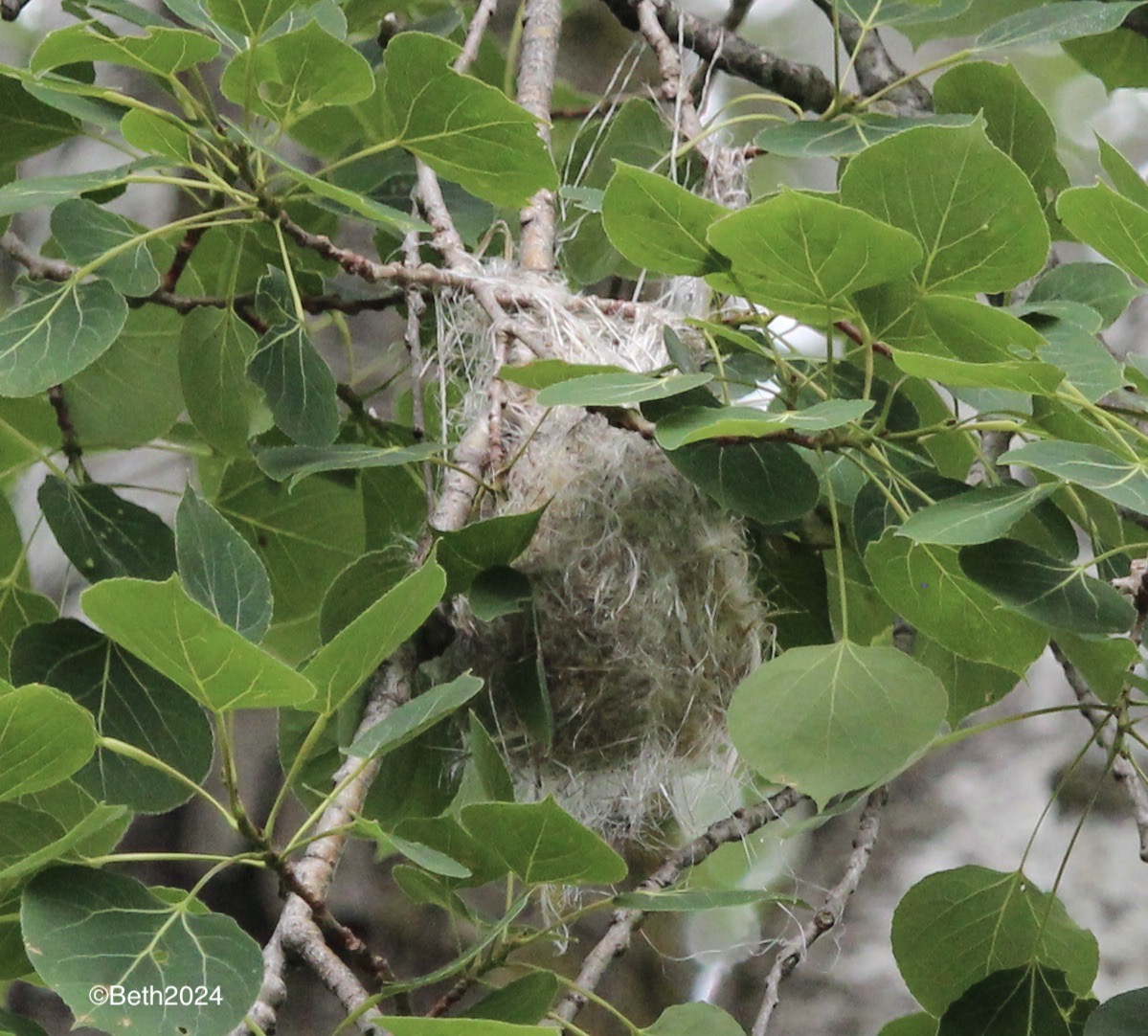
Female Baltimore orioles skillfully weave a hanging nest of natural and artificial materials, such as grapevine, hair, fishing line and twine. They may use wool, down from cottonwood trees or milkweed to line the nest.
When left to their own resources, Baltimore orioles typically eat caterpillars, moths and many other types of insects. Like warblers and flycatchers, they dart out and back from foliage to snatch flying insects. At other times, they remind me of chickadees as they perform acrobatics over and under tree branches in search of beetles, aphids and spiders. They also like flower nectar and fruit, and can sometimes damage fruit crops. During spring and fall migration, our neighbors, Ed and Melinda, keep a fresh dish of grape jelly on their deck railing for the orioles. My father-in-law always suspended fresh orange slices from the bird feeder pole for them. Both delights attracted lots of orioles (and hornets in autumn)!

An immature oriole feeds on grape jelly, one of their favorite foods.
Baltimore orioles spend most of the year on their wintering grounds in Central America, southern Mexico and Florida. They breed in eastern and northern North America as far west as the Central Great Plains and north into southern Canada. Their time in Minnesota is brief: I usually spot my first oriole in mid-May and see the last one in early September. In addition to Baltimore orioles, Minnesota is also the summer residence of orchard orioles and, occasionally, Bullock’s oriole.

Female and immature male Baltimore orioles are sometimes difficult to tell apart.
¹In the Great Plains states, the Baltimore and Bullock’s orioles frequently interbreed and produce hybrid offspring. Between 1983 and 1995, scientists believed that the birds were one species, which they named the northern oriole. Later, genetic testing proved they were two separate species and ornithologists returned to using “Baltimore” and “Bullock’s.”
Sources and Further Reading
 Nature, Garden, Life
I also love orioles. In Colorado, we see mostly Bullock’s Orioles, but also an occasional Baltimore’s or even hybrids, though they are not easy to identify. I can confirm that offering grape jelly and orange slices will attract them to the feeders and bring bright colors to one’s garden.