Early Spring Serenade

A male northern cardinal (Cardinalis cardinalis) sings from his springtime perch .

A male northern cardinal (Cardinalis cardinalis) sings from his springtime perch.

I like the silence of frosty mornings, but I also miss the music of birds during the winter. Most mornings for the past three weeks, our resident cardinal has greeted the sunrise — cloudy or clear — with song. At first he sang one short burst of bright song. Over the next week, it grew to several minutes of song at dawn and another round later in the morning. Basking in Tuesday’s sunshine and 70°, he sang many times during the day. Later that same day, a mourning dove cooed in a spruce tree, chickadees added their lovely two-note calls, and an American robin joined the serenade with its caroling. However, all went silent when a Cooper’s hawk sailed across the backyard and into my neighbor’s silver maple!

Why do birds sing more frequently in the spring? There’s still much to learn, but the thinking is that the increase in daylight triggers a bird’s thyroid-stimulating hormone (TSH). TSH steps up the production of sex hormones to prepare birds for the mating season. A big part of successful reproduction is attracting a mate and maintaining a breeding territory — birdsong plays a major role in both activities.

The four songsters mentioned above were year-round residents in the Twin Cities this past winter.  Soon migrants, such as warblers, red-winged blackbirds, catbirds and others will return to add their harmony to the chorus. In fact, I saw my first red-winged blackbird of the season perched on a cattail in a small pond yesterday. Regardless of its purpose, the return of beautiful birdsong is one of spring’s finest gifts.

In Memory of Cathy Borden

Cathy in 1982 during one of our birding trips.

Cathy in 1982 during one of our birding trips.

My friend, Cathy Borden, died this morning.  She was a teacher, writer, wife, mother, sister, friend, gardener and lover of nature.  She enjoyed watching birds and her favorites were black-capped chickadees and American goldfinches.  Cathy gave me my first birding field guide 35 years ago — and though I’ve purchased other books and apps, that fourth edition of Roger Tory Peterson’s “A Field Guide to the Birds East of the Rockies” is the one I carry on hikes, trips and weekends at the cabin.  It’s worn, wrinkled from hiking in the rain, and out of date.  In large part, it’s the memories of good times and the inscription written by Cathy on the front page that make it special:

“Beth — Here’s hoping you and I have many happy hours together with our books. I’ll pass on the wish that was given to me: ‘May you live long enough to identify every bird in this book!’                    — Cathy Borden, October 14, 1980”

Cathy didn’t live long enough to identify every bird in Peterson’s field guide, and it really wasn’t about the number of birds we identified anyway.  It was the time spent together walking, listening, thinking, discussing and laughing that mattered.  It was taking in the beauty of nature: the golden light of summer mornings in the marsh while warblers sang in willow thickets; autumn leaves burning with the sun’s fire and the silvery seeds of asters, goldenrod, sunflowers and milkweed; bundling up for winter walks in the fields and woods, where we’d flush ruffed grouse and laugh at being startled; and discovering spring’s first wildflowers and bird nests.

Over the years, career changes, raising families, caring for aging parents and other responsibilities became the focus — particularly for me.  I regret not making nearly enough time for nature walks, discussions over tea, or long phone calls with Cathy.

Cathy loved this simple nature blog.  She was a big supporter from the beginning and often chided me because she wanted me to write more frequently. During this past year, I blogged for Cathy, as one small way to bring her joy while she fought metastatic peritoneal cancer.  So it seems fitting to dedicate my blog to Cathy in gratitude for so many things—support and friendship beginning when I was a first-year science teacher; giving laughter that lightened times of tough challenge; sharing the beauty of nature through walks in every season; and the gift of holding her with one of her sons this morning.  No doubt Cathy’s exploring the celestial fields and woods, and working on her new bird list right now. 

Dedicated to Cathy Borden, October 11, 1951 – January 27, 2016, who loved chickadees, goldfinches, lilacs, lilies of the valley, bumblebees and the sound of crickets chirping in the night.

Pileated Acrobatics

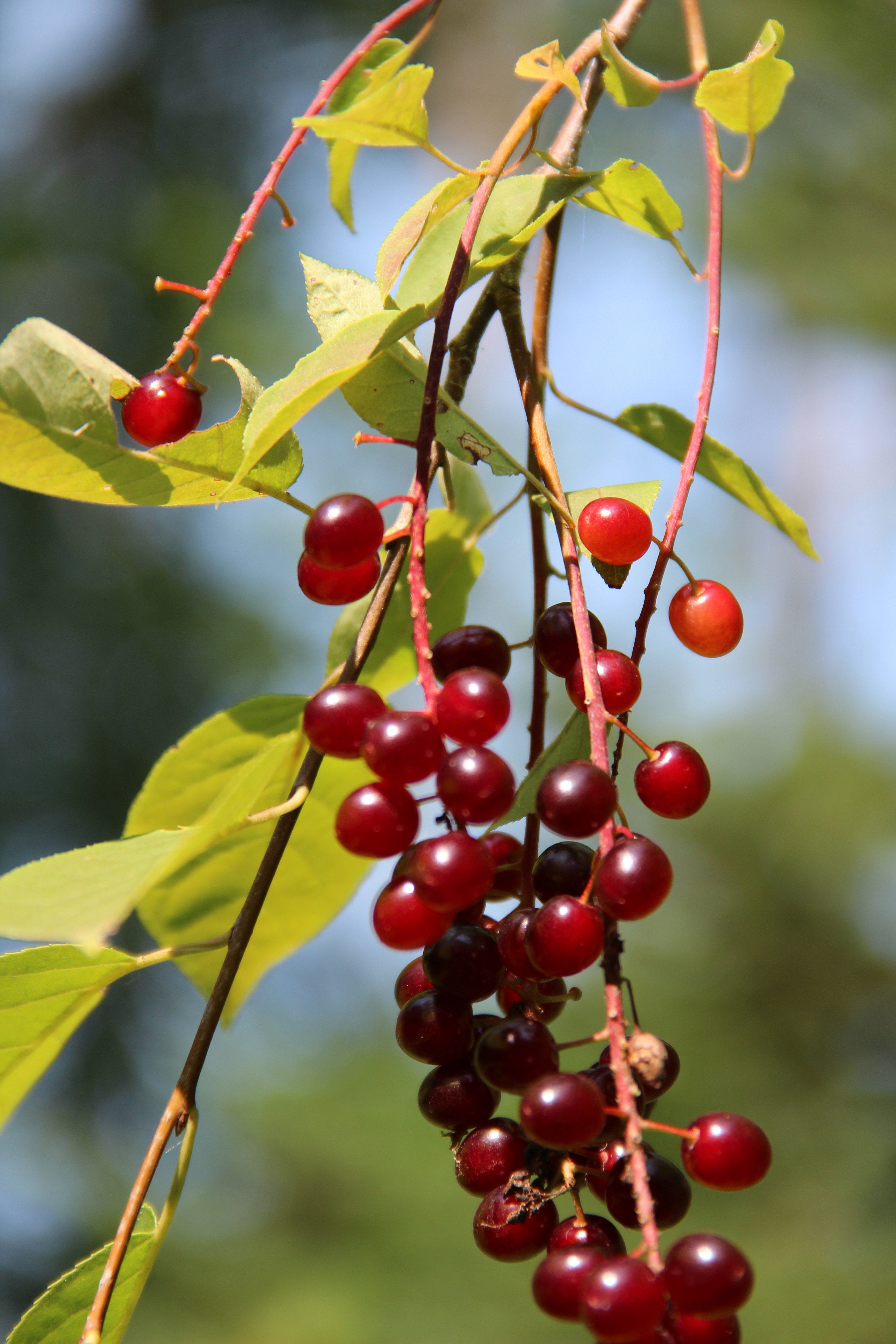
The bush seemed too weak to support the pileated woodpecker’s (Dryocopus pileatus) size and heft.  Catbirds, robins, chipmunks and squirrels easily picked the ruby and purple fruit from the spindly chokecherry branches.  But, the crow-sized woodpecker struggled to alight and balance in the bush.  Its black forehead and mustache stripe identified this pileated as being a female. First, she flew straight into the bush, but the branches bent and sank under her weight.  Next, the woodpecker landed in each of the bur oak trees that flank the chokecherry and then dropped into the bush; still unsuccessful.

pileated5

When we returned to our cabin on the Snake River the following weekend, she had solved the problem.  Sometimes the pileated used her wings and tail to brace herself — even hanging upside down.  At other times, she seemed to pluck the fruit from midair.  The beauty of her wings unfurled in waves of ivory and black that thwacked the air.  Her red crest glowed like a flame in the bush.

pileated1

pileated4

pileated3

Though pileated woodpeckers primarily eat insects such as carpenter ants and beetles found in bark, they also eat a variety of berries and fruit, and sometimes visit our backyard suet feeder in St. Paul, Minnesota.

Chokecherry fruit (Prunus virginiana).

Chokecherry fruit (Prunus virginiana).

Our deck is just 6 feet from the bush, and if we were silent and still, the woodpecker payed no attention to us.  When I tried to photograph her she flew immediately.  As a result, I had to photograph her through the cabin windows, which reduced photo quality.

Gray Catbird: Mimic Extraordinaire

He’s the musical sort.  He sings with the robins and cardinals; not just his song, but theirs, too.  First he mimicked the robins’ morning song, then he imitated the cardinals and red-eyed vireos.  He blended their calls into his own unique arrangement of a song with many repeated phrases.  I suspected a gray catbird (Dumetella carolinensis) when I heard his “meow”-like call.  Catbirds skulk around in thickets and tangled hedges, so are often hard to see (I haven’t been able to photograph him).  Later, the cardinal pair that frequents our backyard chased him out of the arbor vitae hedge and I spotted him.

He’s a fine looking charcoal-gray bird, about the size of a small American robin, with a black cap and a rusty patch under his tail.  Like brown thrashers and mockingbirds, gray catbirds have the ability to imitate the songs and calls of other birds, creatures and even machines.  Female catbirds sing too, but more softly and infrequently than their mates.

After declaring his territory for three or four days, he began a nighttime serenade, which he continued nightly for three weeks.  At his most vocal, he started singing shortly past midnight.  His song alone filled the night air and varied from melodious bird calls, to squeaks, whistles and other sharp, clear sounds.  He sings to defend his territory and to attract a mate.  Most recently, he’s added part of the American goldfinch’s call to his repertoire. He may mimic fragments of other avian songs too, but I am only certain of the four I’ve mentioned.  He often returns to the hedge to sing at dawn, though no longer with the same intensity and frequency.

Does it matter that catbirds imitate other birds’ songs and calls?   The theory, according to Greg Budney, audio curator at Cornell’s Macauley Library, is that the greater intricacy of a male catbird’s song demonstrates his greater experience with life and survival — and therefore makes him a stronger candidate for a good mate.  There’s an interesting, short video that features a catbird mimicking several songs of other bird species and a chorus frog.  Budney identifies each imitated song and briefly explains his theory.

I’m sure our catbird’s a fine fellow and mate — but I just appreciate hearing his joyful noise in the garden.  Anyone else have catbirds in their yard, garden or woods?

Early Spring

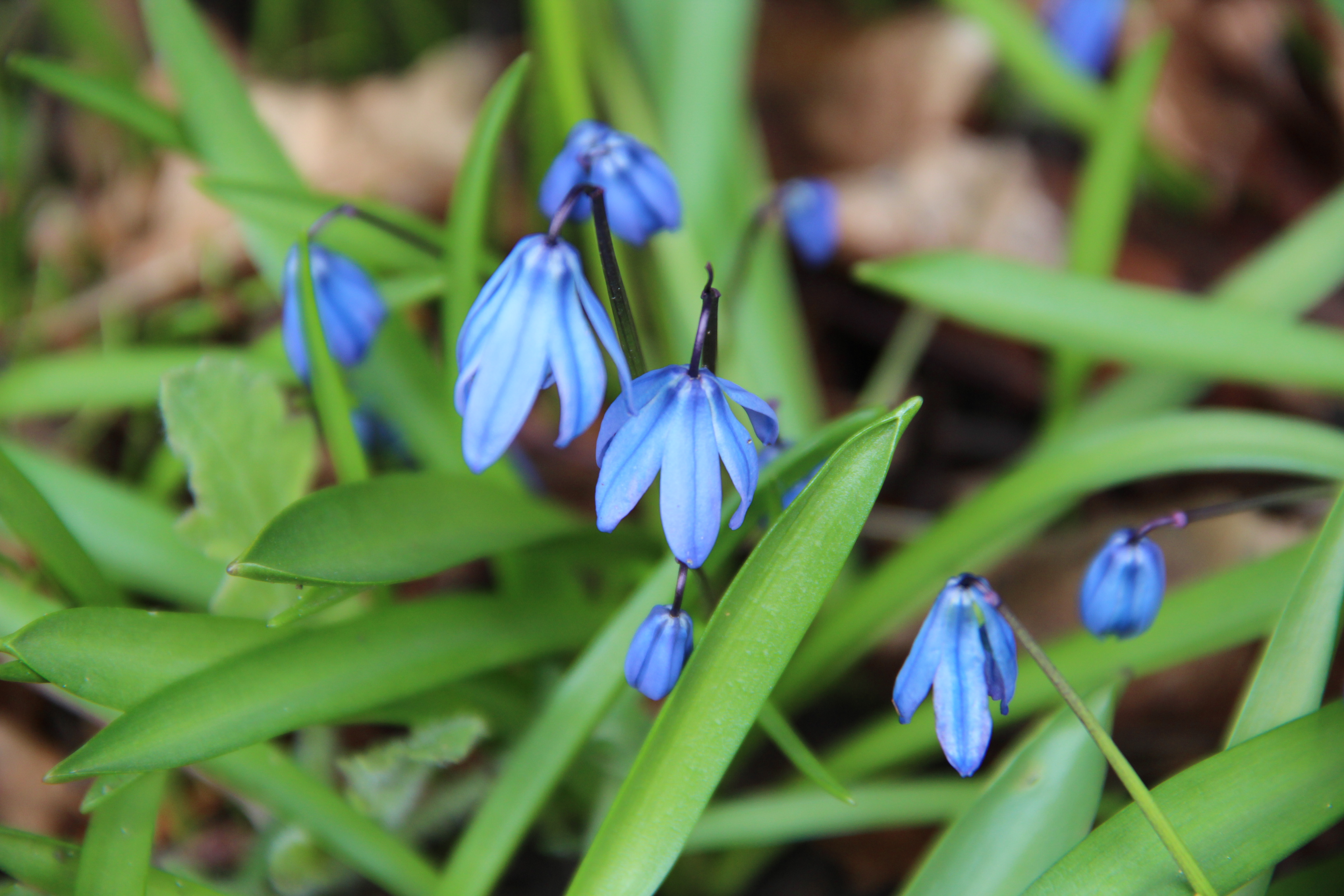
Spring is slow in coming this year; but over the past two weeks, the awakening of life has softened the dingy, post-winter landscape.  Summer bird migrants add their songs to the morning chorus; maples, Canada cherries and other trees bud; chipmunks dart about in the yard; and the early spring bulbs begin to bloom — among them my favorite: the beautiful blue squill.

Siberian Squill (Scilla Siberica)

Siberian Squill (Scilla siberica).

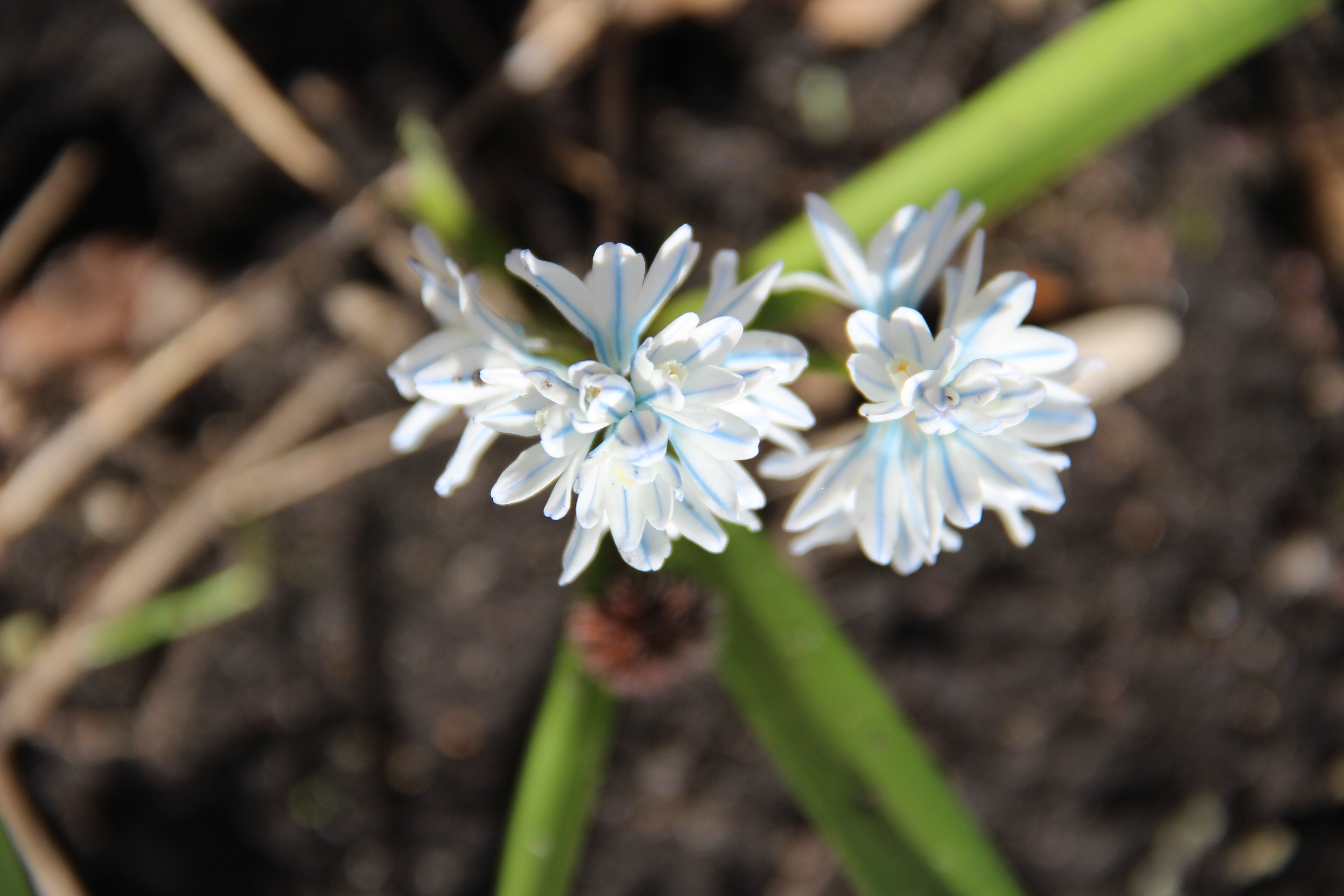
Striped Squill (Puschkinis scilloides).

Striped Squill (Puschkinis scilloides).

Crocus buds (Crocus spp 'ladykiller).

Crocus buds (Crocus species ‘Ladykiller’).

Crocus blossoms (Crocus spp 'ladykiller')

Crocus blossoms (Crocus species ‘Ladykiller’)

Red Maple Flowers (Acer rubra).

Red Maple flowers (Acer rubrum).

Canada cherry (Prunus virginiana 'Canada Red') leaves and flower buds

Canada Cherry (Prunus virginiana ‘Canada Red’) leaves and flower buds.

White-throated Sparrow (Zonotrichia albicollis) © T.M. Murray 2014; used with permission.

White-throated Sparrow (Zonotrichia albicollis) © T.M. Murray 2014; used with permission.

White-throated sparrows are migrating north and add a melodious, clear whistling to early spring mornings.  Once you’ve heard the song, it’s easy to remember.  Many people liken it to the phrase, “My Sweet Canada, Canada, Canada”.  This sparrow has a bright white throat, a black-and-white striped crown and a bright yellow spot between the eyes and bill.  Listen to and watch a white-throated sparrow whistle its lovely, plaintive song.


Eastern chipmunks (Tamias striatus) are out of their dens.

Eastern Chipmunks (Tamias striatus) are out of their winter dens.

American robins (Turdus migratorius) are building nests.

American Robins (Turdus migratorius) are building nests.

Newly opened Glory-of-the-Snow (Chinodoxa).

Newly opened Glory-of-the-Snow (Chinodoxa).

A patch of striped squill and Siberian squill in our garden.

A patch of Striped Squill and Siberian Squill in our garden.

Hermit Thrush Visitors

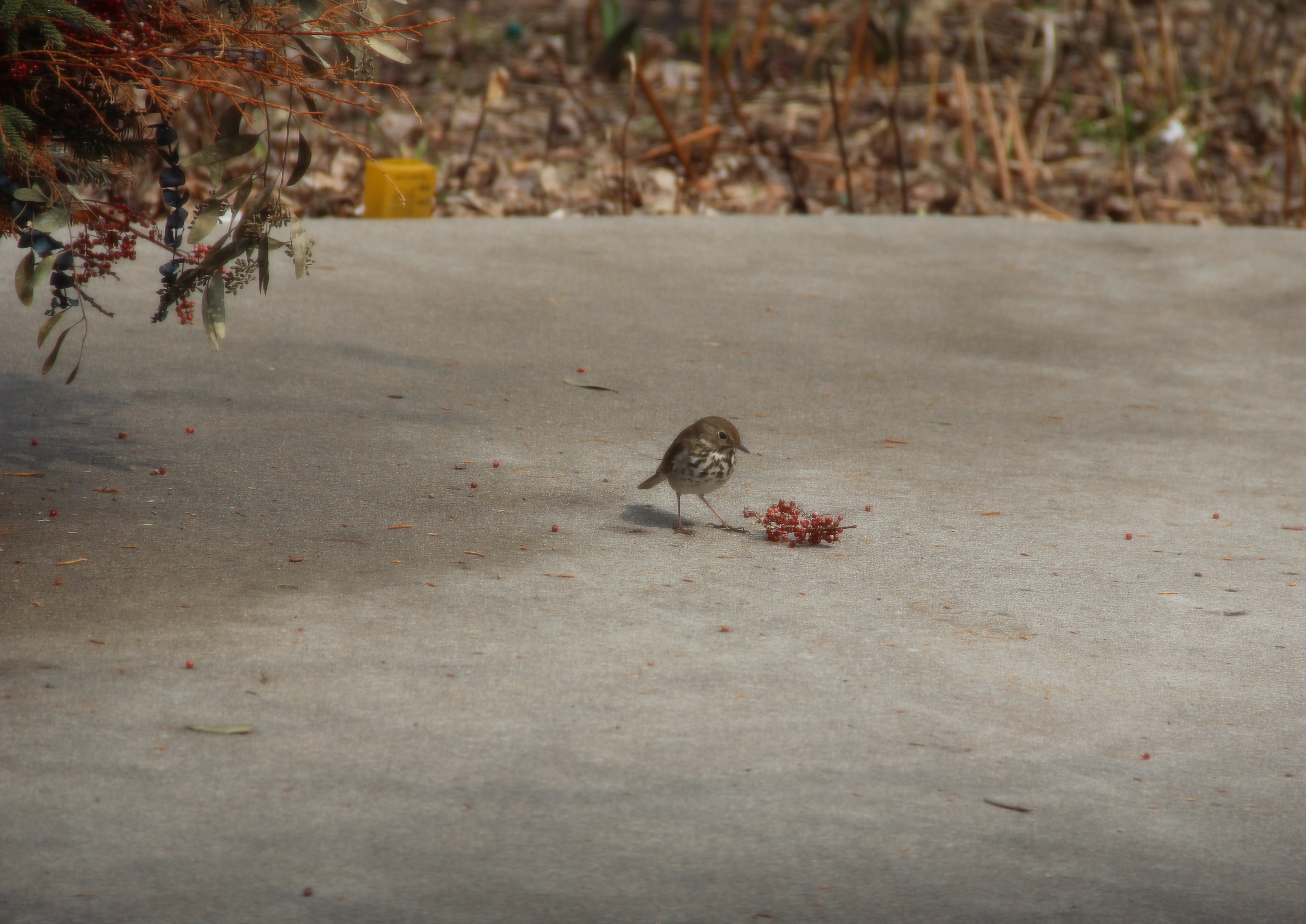
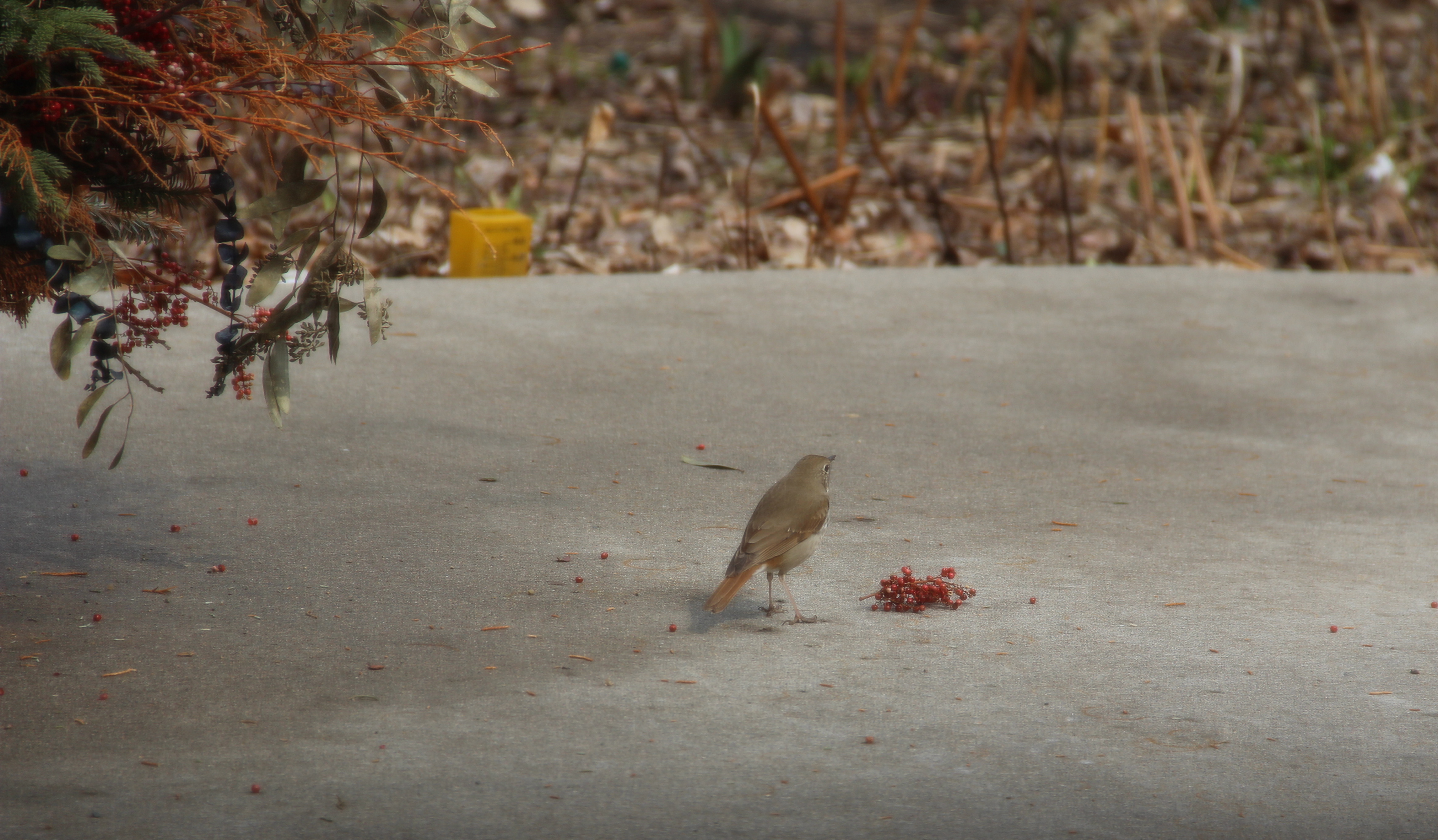
A hermit thrush eats berries from our patio planter.

A hermit thrush eats berries from our patio planter.

Recent strong winds brought a pair of migrating hermit thrushes to our backyard.  Their brown backs, spotted breasts and rust-colored tails camouflaged them well among the leaves littering the gardens and against our winter-weary lawn.  They plucked berries from a planter on the patio, picked in the grass under the suet and thistle feeders, and turned over leaves in the garden in search of food.

Cousins to American robins, eastern bluebirds and several other thrushes, hermit thrushes may be the best singers of the family. Their song is flute-like, liquid, melodious.  In Minnesota, these songsters spend the summer in the north-central and northeastern regions of the state.  It is rare to hear a hermit thrush sing during migration, and over the many years that migrants have rested in our yard, I’ve heard their ethereal singing only once  —  when a bird perched in a tall arbor vitae and sang on a sunny morning.  Watch and listen to a hermit thrush sing its haunting song.

hermit4

A rust-colored tail helps identify the hermit thrush.

Some thrush species can be tough to tell apart because of the spotted breast and brown coloring shared by many. But, if the bird has a rusty tail that it flicks up and down, you’ll know you’ve likely spotted a hermit thrush!


Morning Song

Each morning between 6:00 and 6:30, a male cardinal perches in the arbor vitae at the back of our yard and sings in the predawn darkness.  His melodious whistles serenade his mate, define his territory and bring cheer to the cold morning.

When the sun is higher, he whistles a more intricately patterned call.  Soon his mate comes to feed at the suet brick while he watches from the cedars, a red ornament decorating the green fronds. His lady is softly colored in olive and brown highlighted with pinkish red.  I haven’t heard her song yet this year, but female cardinals are able to sing as lovely as males, and soon she will join him — especially when they begin nesting, to communicate location and the need for food.

This cardinal pair has nested in our hedge for the past two summers.

This cardinal pair has nested in our hedge for the past two summers.

Why does the sight of a cardinal bring joy to so many people? Cardinals are common, year-round residents throughout most of Minnesota, the eastern United States and Mexico. Yet, spotting a flash of red in a tree top, at a feeder, or in a garden is always delightful.  For me, it is because cardinals sing when most other birds are silent — on frigid late-January mornings and sweltering late-summer afternoons; and because, most summers, they raise a family in the hardwood hedge in our backyard; and, simply for their red brilliance against the winter landscape or among the purple and gold in our September garden.  A common bird, perhaps; uncommonly beautiful, most certainly.

2014 TM Murray; used with permission.

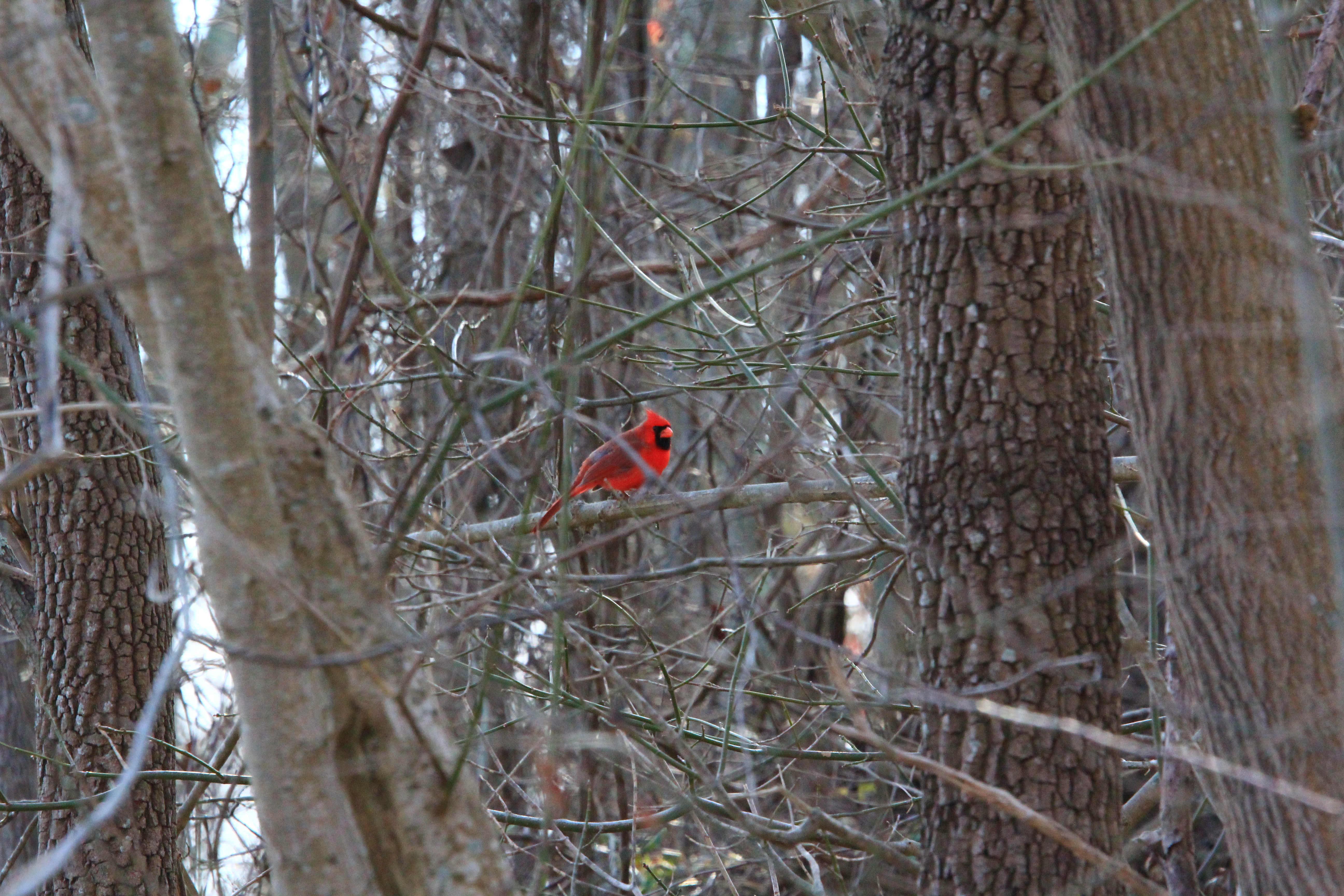
A male cardinal glows in the stark winter woods.  © 2014 T. M. Murray; used with permission.

On the Banks of the Snake River (St. Croix Basin)

It’s a breezy, clear, mid-August morning at the Snake River in east central Minnesota.  An old silver maple creeks in the wind and a pileated woodpecker’s call rings through the woods.  Trees, thickets and river grasses show lush shades of green.  I am so glad to see no hint of autumn in them yet. But, other plants tell a different story.  The berries of false Solomon’s seal grow red, chokecherries and currants ripen to purple, and hawthorne fruit and wild rose hips begin to blush.  Hickory and hazelnuts are plump and the fragrant basswood flowers of a few weeks ago are now little round nutlets.

False Solomon's Seal Berries

False Solomon’s Seal Berries

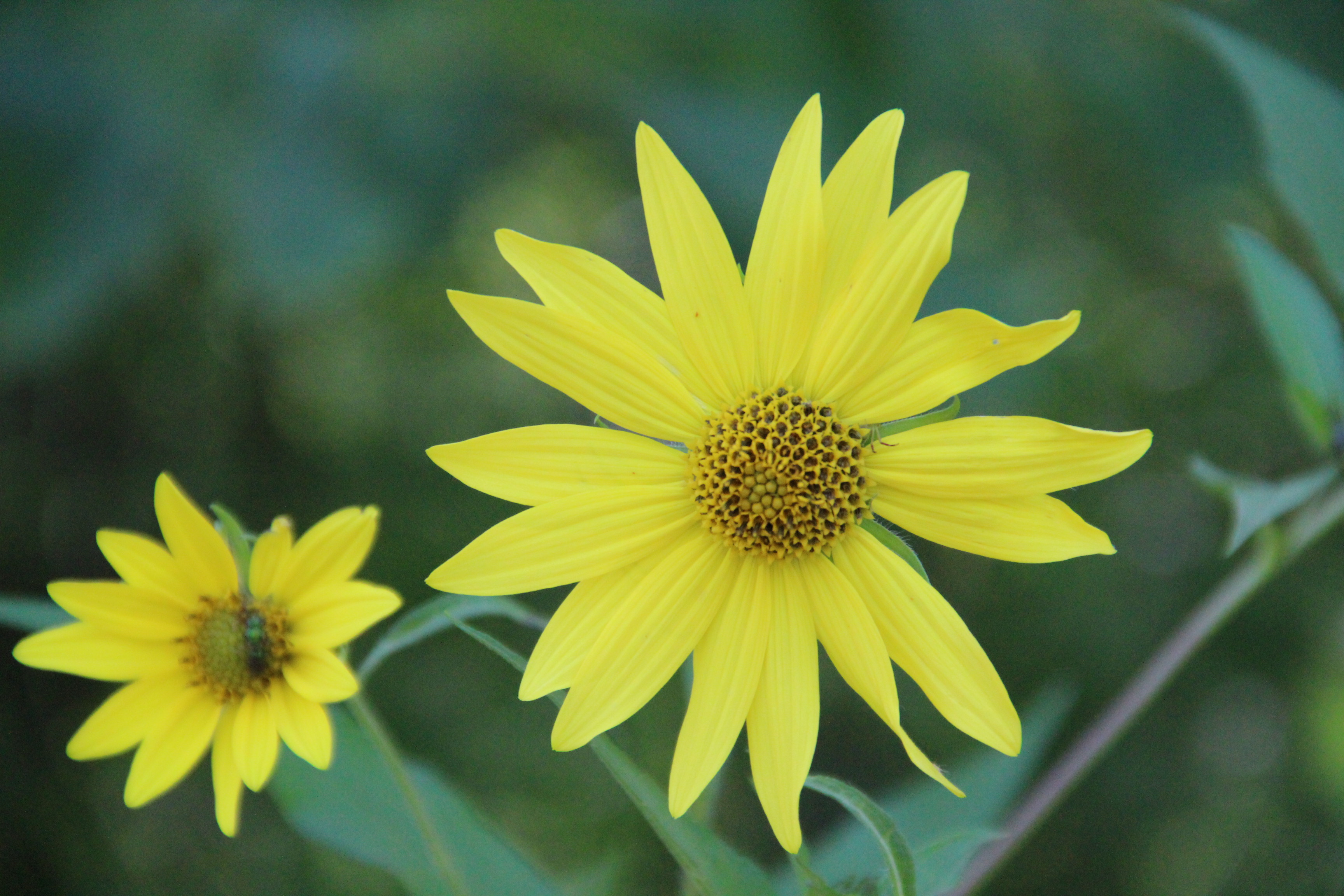
Flowers are changing too.  Turk’s-cap lilies, meadow rue and vetches have been replaced by woodland sunflowers and lesser purple fringed orchids.  The first goldenrod buds are turning yellow, and harebells and heal-all continue to bloom.

Woodland sunflower

Woodland sunflower

IMG_3378

Lesser purple fringed orchid

The woods are much quieter than in July.  Most birds have finished breeding and their babies have grown, putting an end to the feeding frenzy.  I miss the morning and evening chorus — especially the ethereal vespers sung by the wood thrushes.  Fortunately, the last few mornings, a family of five blue jays visited our hazelnut thicket.  They call softly to each other as they pluck the nuts, hold them against a tree branch and peck open the husk.  These jays are more elusive than the jays in our city yard.  They retreat deeper into the woods when I sit outside and try to photograph them.

In the late afternoon, a lone cicada buzzes.  Grasshoppers and crickets trill softly and are joined by snowy crickets and katydids in the evening.  Their night music, though simpler than birdsong, complements the burble of river water over rocks and gently soothes as darkness falls.

Baby Birds

Early August and the neighborhood is filled with the calls, chirps and squeaks of the newest brood of baby birds. As I write, a baby cardinal sits in our hedge and begs for food. Its father plucks cherry tomatoes from a patio plant to feed it and chases away house sparrows that try to land anywhere nearby.

Image

Baby cardinal.

Robin parents feed their fuzzy chick under the shelter of an arbor vitae stand.

Baby robin.

Baby robin.

An American goldfinch male now dines alone in the monarda patch; his mate probably incubates their eggs nearby.

IMG_3358

American goldfinch in native monarda.

Common Milkweed

Monarch butterflies are rare this summer.  I’ve seen just one in our St. Paul, MN, garden, even as monarda, swamp milkweed, common milkweed, black-eyed Susan’s, Joe-Pye weed, phlox and a blend of other native plants and garden perennials bloom.  However, we have no shortage of milkweed to nurture monarch caterpillars if they were present.  A lush patch of common milkweed (Asclepia syriaca) grows in our yard, possibly the best-ever since I spotted the first plant shooting up in the middle of a juniper hedge 15 years ago.  The first milkweed blossom opened on July 7 and  most of the plants were flowering by July 17.

Image

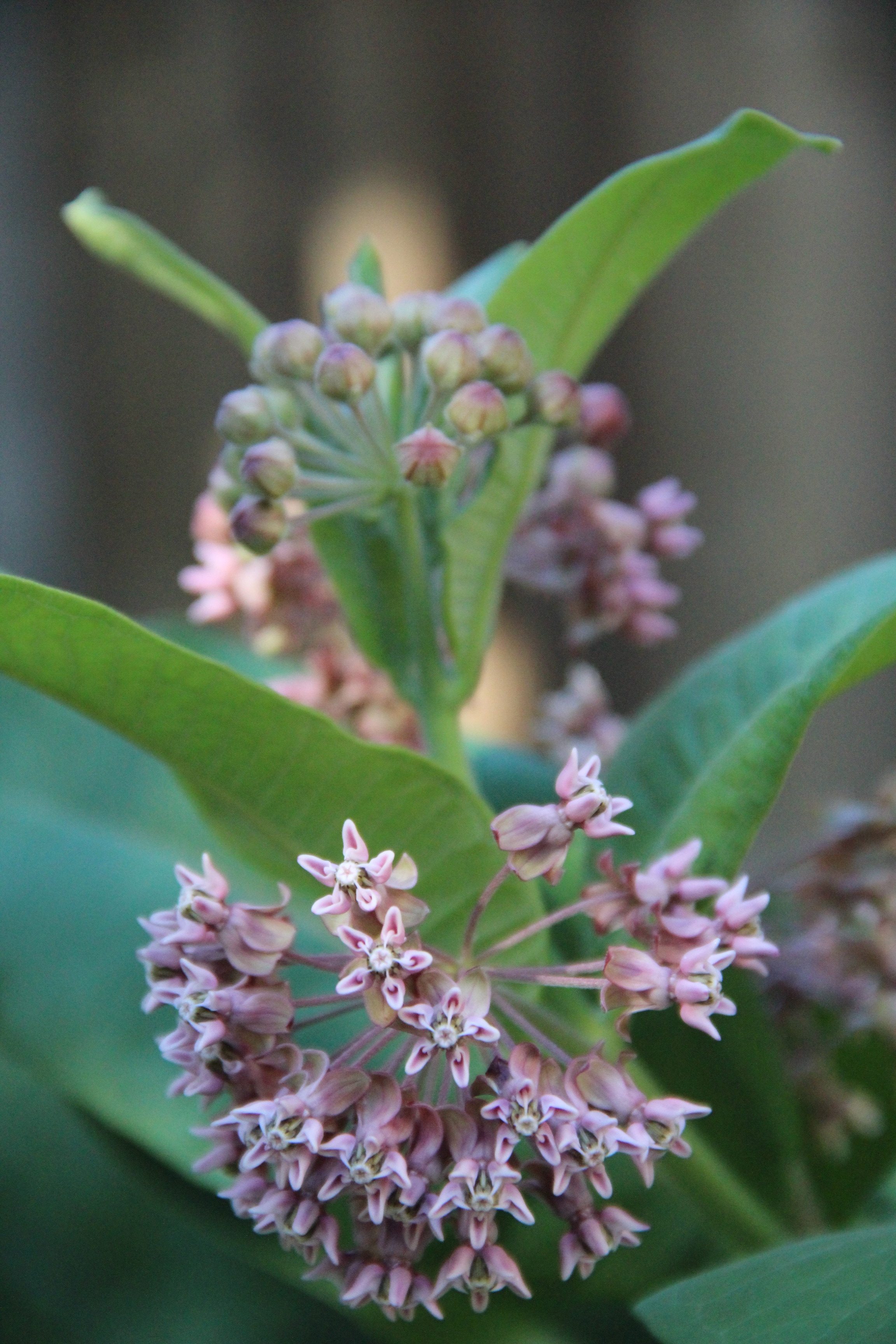
Milkweed buds and blossom.

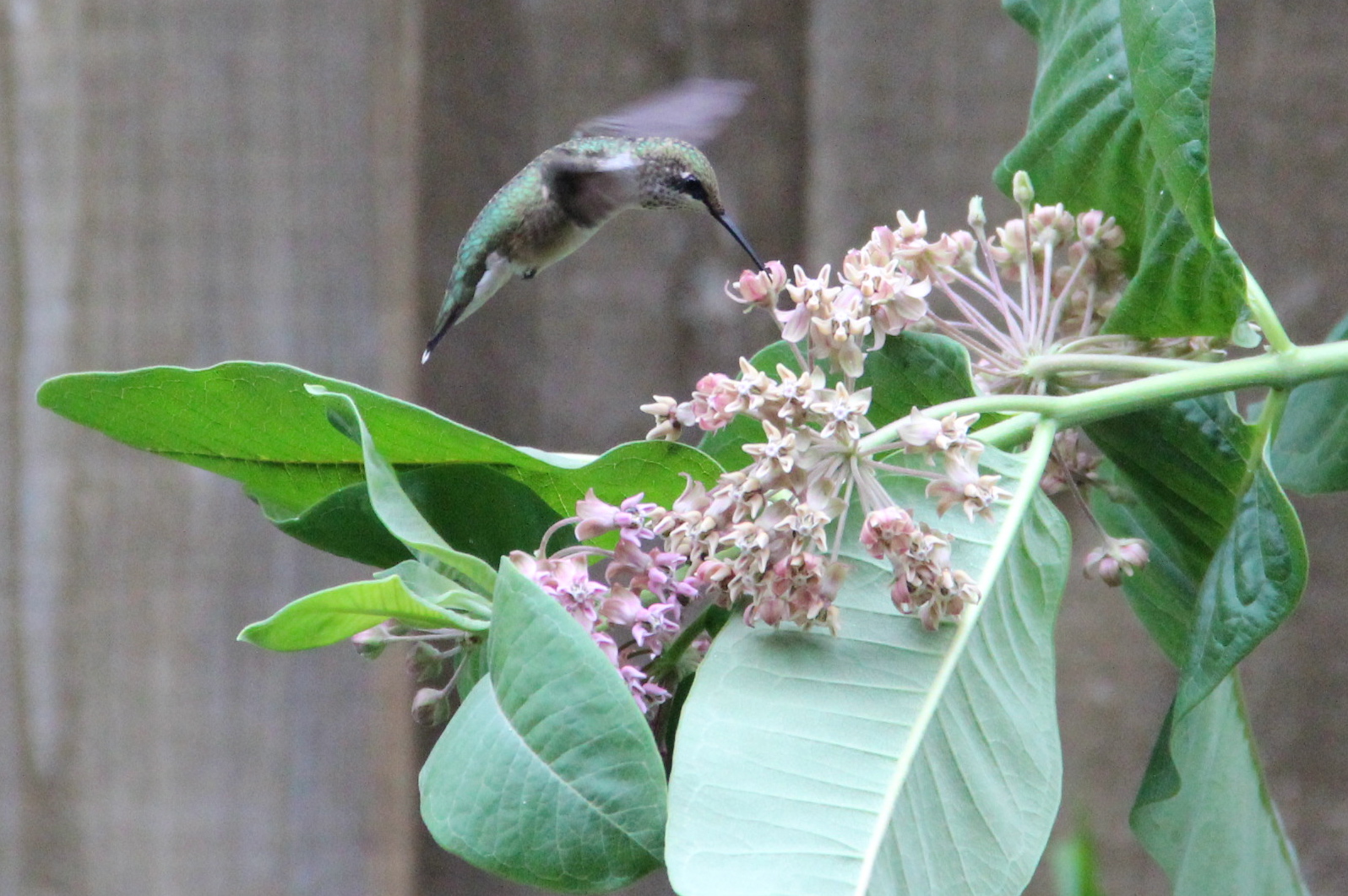
Though monarchs are absent, red milkweed beetles, bumble bees and ruby-throated hummingbirds frequent our patch.

Image

Red milkweed beetle on swamp milkweed.

Image

Ruby-throated hummingbird sips milkweed nectar.

On July 22, I noticed the first seed pods.  New pods continue to form and the earliest pods have plumped-up in the past week.

Image

Newly formed milkweed seed pods.