Beyond Monarchs and Viceroys

Great-spangled fritillaries sport a checkerboard pattern on their dorsal wings. A creamy yellow band separates silvery spots or “spangles” on the ventral surfaces.

In late summer, chances are good that you’ll notice lots of orange-and-black butterflies in gardens, meadows or roadside areas. But, not every one that you see is a monarch, or its look-alike, the viceroy. Fritillaries, another group of large orange-and-black butterflies, are on the wing into September in the Upper Midwest, favoring open sunny gardens, grasslands, and meadows.

Fritillary comes from the Latin word “fritillus,” which means checkerboard or dice — and most butterflies in this family sport a checkered design on their wings. Of Minnesota’s 12 fritillary species, the most widespread are the great-spangled, Aphrodite, Atlantic, silver-bordered, meadow and variegated.

I’ve spotted great-spangled fritillaries (Speyeria cybele) in our garden and along country roads where I’ve recently walked. The largest of Minnesota’s fritillaries, with a wingspan of 2.5-to-4.0 inches, great-spangled adults display an orange, brown and black pattern of stripes, dots and bars on their upper wings. The undersides of the hindwings shimmer with two rows of large silver spots (referred to as spangles) separated by a wide, creamy yellow band not seen in other fritillaries.

Faded colors and worn, jagged-edged wings indicate an elderly great-spangled fritillary nectaring on this thistle.

In June, great-spangled males appear first, followed by females about a month later. Females lay eggs in late summer and fall, placing them singly, on or near the base of common violet species (viola) — violets alone are the host plant for their larvae. The caterpillars hatch in the autumn, but stay hidden in leaf litter until the following spring when violets are freshly growing. Caterpillars are black with reddish-orange knobs that give rise to black spines. They are secretive and only feed at night.
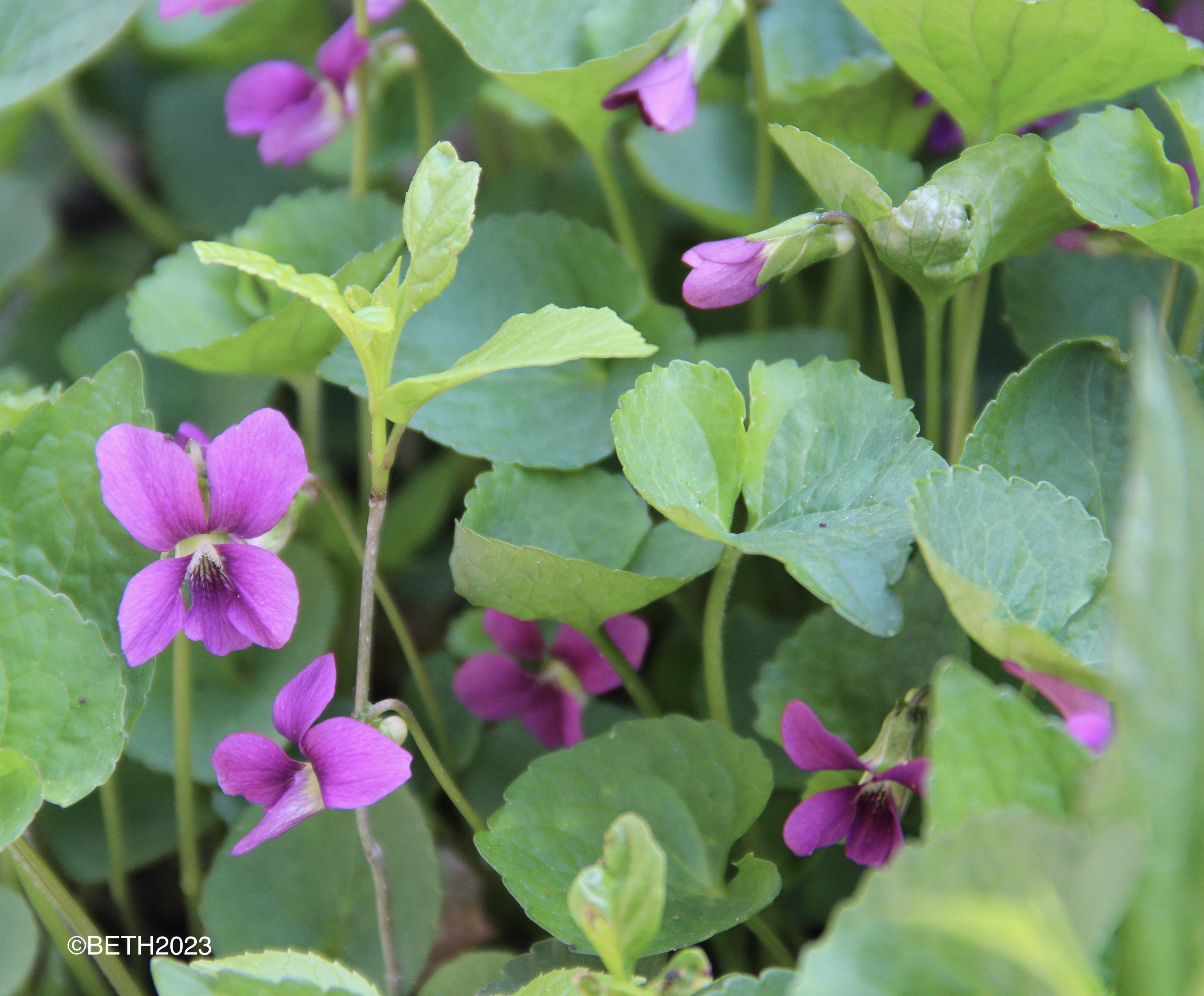
Great-spangled fritillary caterpillars, and many other fritillary larvae, feed only on violet (viola) species.

Unlike their violet-dependent larvae, adult fritillaries nectar on many different flower species, including milkweed, clover, black-eyed Susan’s, vetches, thistles, Joe-Pye, monarda, members of the mint family, dogbane and many types of coneflowers. Fritillaries are preyed upon (especially the caterpillars) by dragonflies, paper wasps and other large insects, spiders and birds.

What can you do to help these beautiful pollinators? If you have violets in your garden, don’t weed them all out. Without violets, there would be no fritillaries! Leave a few in your garden or yard year-round for great-spangled and other types of fritillary caterpillars to eat.

Most common in eastern North America, great-spangled fritillaries range from British Columbia across southern Canada and the northern United States to the Atlantic, south to central California, northern New Mexico and northern Georgia.                              

Leave a few violets tucked into your garden so that fritillaries can lay their eggs on them in the fall. Caterpillars will feed on them in the spring.

Sources and Further Reading

Butterflies and Moths of North America

North American Butterfly Association

University of Kentucky Entomology

Weber, Larry. (2006). Butterflies of the North Woods. Duluth, Minnesota: Kollath & Stensaas Publishing

More Than a Weed

I’ve battled bishop’s weed (Aegopodium podagraria) in my garden for 35 years.¹ As much as I detest it, (please don’t plant it), I’ve learned that what’s despised by one creature may mean survival to another. Bishop’s weed, a member of the parsley family, is one of a small number of host plants or “homes” for native black swallowtail butterfly caterpillars.²

A black swallowtail caterpillar (Papilio polyxenes) feasts on bishop’s weed, a member of the parsley family.

As I dug out the weeds a couple of weeks ago, I spotted a caterpillar with light blue-green and black stripes dotted with yellow. The clues to its identity were its location on a member of the parsley family, the only plant type that black swallowtails live on and eat, and the color and pattern of its stripes. (It looked similar to a monarch, but monarch caterpillars only eat milkweed and their stripes are yellow, black and white.) I searched through the rest of the bishop’s weed and found a second caterpillar. In May I’d seen an adult black swallowtail visiting the weed, where it must have deposited eggs.
Two rows of well-defined yellow spots help to distinguish the black swallowtail from other swallowtail species in our area.

Not a rare butterfly, but a handsome one, the black swallowtail (sometimes called the parsley swallowtail) is native to the eastern United States and Canada. Its body and wings are black with highlights of yellow, blue and orange. The tail ends in two narrow lobes that give it the common name of swallowtail. Two rows of bright yellow spots mark the wings. The hindwings are blue in the area between the yellow rows near the tail. Each hindwing ends in a circular reddish spot. The underside of each wing has rows of light yellow spots, with bands of orange separated by spatterings of blue. Females usually show more blue coloring and males usually have more yellow. The wing span is 3.5 – 4.5 inches, with the female generally larger than the male.

The undersides of the hindwings are marked with bright orange and a dusting of blue.

In the Upper Midwest, black swallowtails produce two generations of offspring between May and October. The second generation overwinters in a brown chrysalis until the following spring. The caterpillars in my garden probably hatched in May. Depending on weather conditions and host plant availability, the eggs hatch in three-to-nine days. The caterpillars eat and grow through five stages, or instars, as they increase in size and change in appearance, which may take up to 30 days. The mature caterpillar forms its chrysalis and molts one final time. The ones I saw will leave their chrysalises in two-to-three weeks as mature black swallowtails ready to produce the next generation. Adults nectar on clover, milkweed, thistle, bee balm and other perennials. Watch for them to be on the wing in July — and, consider growing one of the more well-behaved members of the parsley family, such as dill, carrot, parsley or sweet fennel, on which this lovely creature can live and dine!

1Also known as goutweed and ground elder, this non-native member of the parsley family was imported and marketed as a fast-growing ground cover that was frequently planted with European buckthorn (Rhombus cathartica) and creeping bellflower (Campanula rapunculoides). There’s also a variegated form called snow-on-the-mountain. Over the years, we’ve had it chemically treated, dug out and the soil replaced, but it returned each time. Now, I just try to prevent it from spreading.
²Other members of the parsley family include carrot, dill, sweet fennel, Queen Anne’s lace and, of course, parsley.

Further Reading:

Butterflies and Moths of North America

Wisconsin Horticulture – UW-Madison

Weber, Larry. (2006). Butterflies of the North Woods. Duluth, Minnesota: Kollath & Stensaas Publishing.

October’s Painted Lady

A painted lady’s (Vanessa cardui) underwing sports four eyespots and pink patches. It is nectaring on asters (Symphyotrichum oblongifolium).

Mild October days bring butterflies to our garden. We commonly see red admirals, painted ladies, commas and tortoiseshells, but in 2022, I’ve seen fewer numbers of butterflies all season. The only painted lady (Vanessa cardui) that I’ve spotted appeared in late October on a mild, sunny day (77°F/25°C). 

It spent hours nectaring on late-blooming asters in the company of many bees, and flew energetically around the garden every few minutes. While most of the native bees perished in a hard frost (24°F/-4°C) more than two weeks ago, a few hearty bumblebees survived, as did the honey bee colonies. Bees and butterfly got along well and were simply focused on collecting nectar for energy. As I gardened nearby, the gentle humming of the bees was soothing and complemented the rustling of falling scarlet-red maple leaves.

A painted lady’s upper wings carry black and orange markings with a few white spots near the wingtips.

Two days later, the painted lady disappeared from our garden on a warm wind heading south. I miss them during the long northern winter. Also known as the “thistle butterfly,” (because thistles are a favorite food source for both caterpillars and adults), painted ladies migrate to wintering grounds in the southern United States and Mexico to return in late spring.

Further Reading:

Weber, Larry. (2006). Butterflies of the North Woods. Duluth, Minnesota: Kollath & Stensaas Publishing.

Painted Ladies – Nature, Garden, Life

Painted Lady Butterfly – Wisconsin Horticulture

Cherish the (Butterfly) Ladies – UW-Milwaukee Field Station

Butterfly Sampler

A painted lady (Vanessa cardui) basks in the sun on a roadside rock to warm its flight muscles.
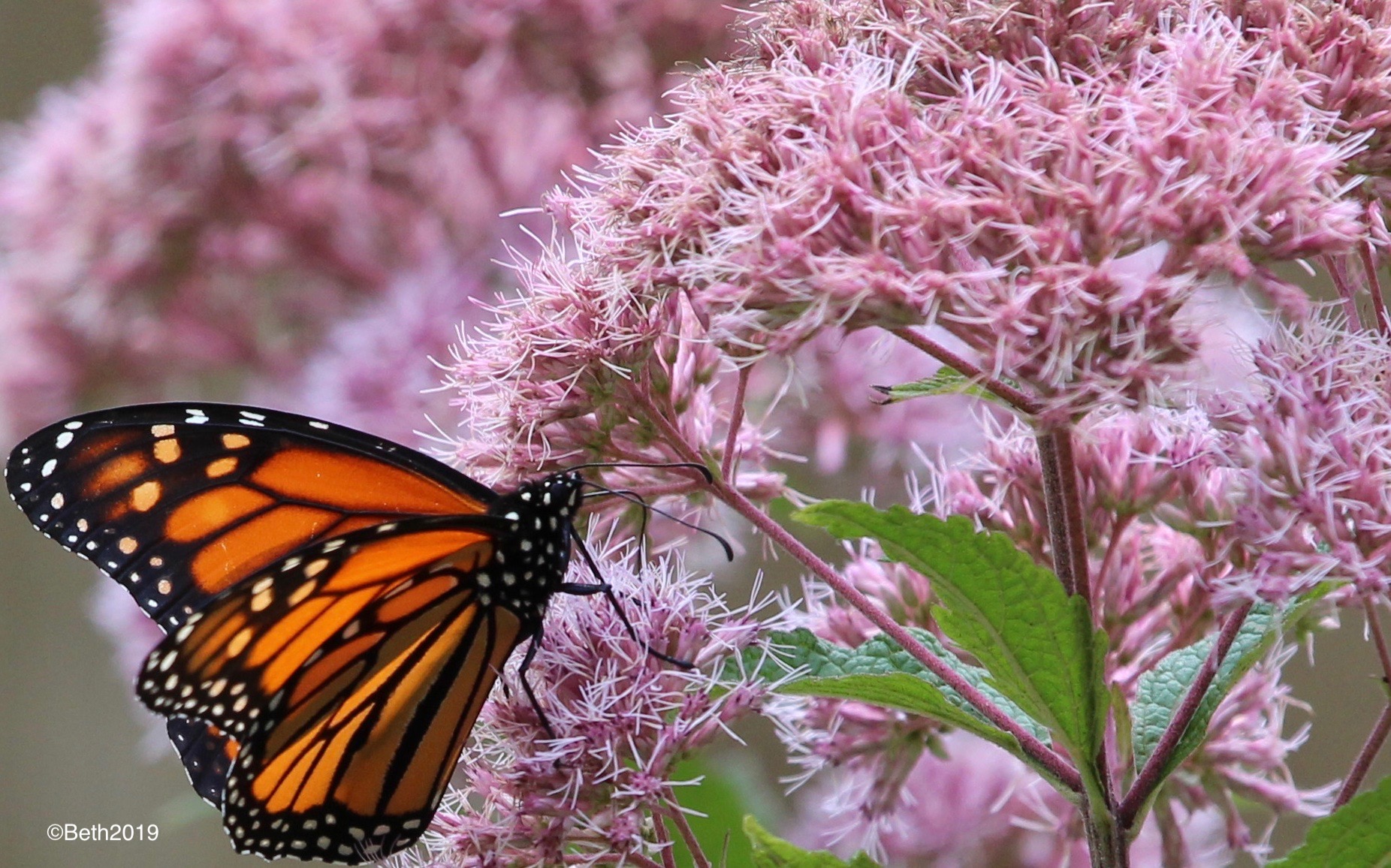
Like miniature floating tapestries —  stippled, spotted and striped — they decorate gardens, yards and roadsides. Butterflies are plentiful this summer. Alongside the bumblebees, they pollinate many flower species and aid with seed production. But honestly, I love them more for their color, grace and elusiveness; for the joy they evoke in the eyes of children and the hearts of people of all ages. I delight in the first and last of every season — often a mourning cloak or red admiral in late April and a tortoise shell or red admiral in October.

Here are a few of the butterflies I’ve seen recently:

Eastern-tailed blues (Everes comyntas) are active May – September in the Upper Midwest and southern Canada.

This hackberry emperor (Asterocampa celtis) was attracted by sweet apple juice in my pail of apple windfalls.

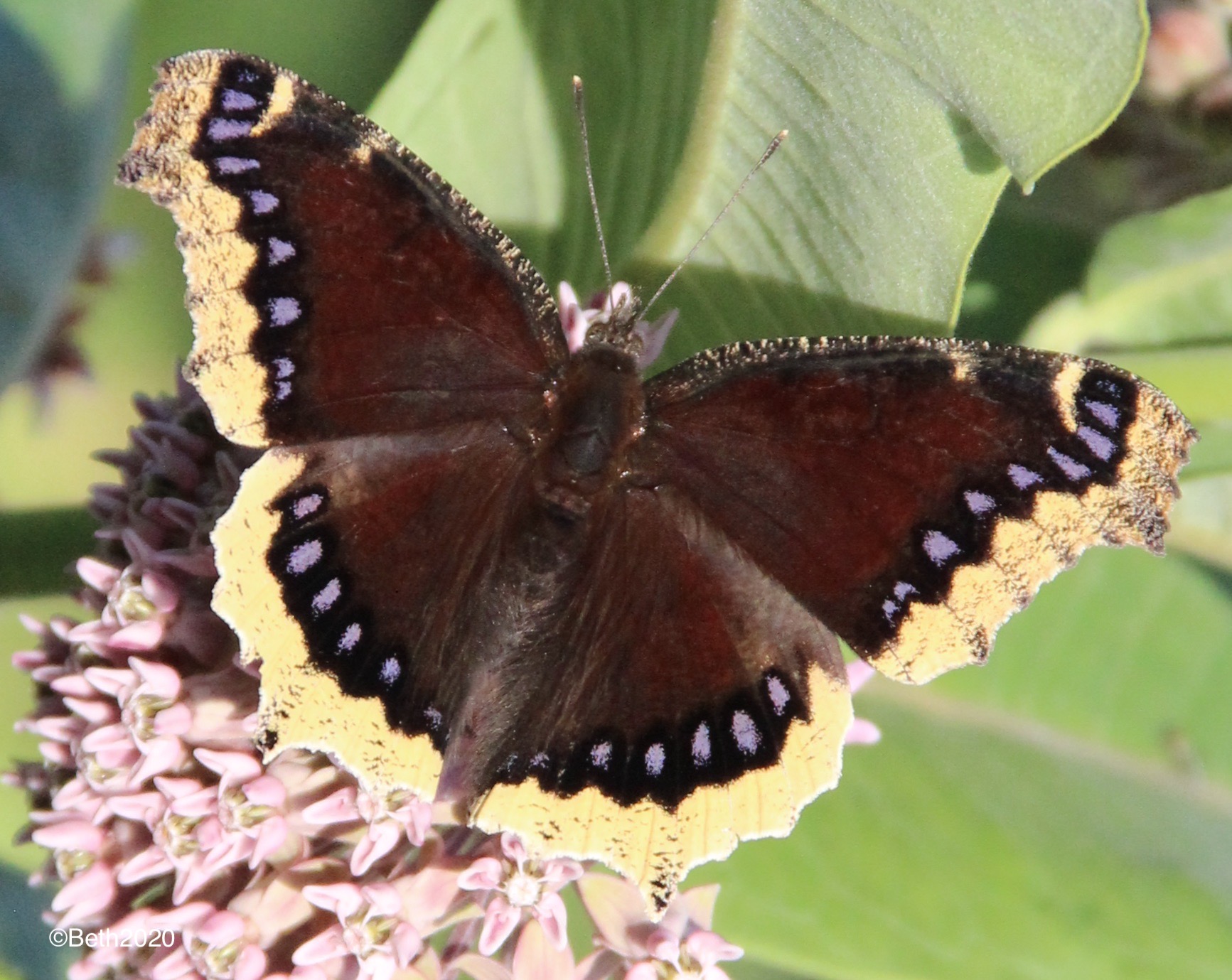
Mourning cloaks (Nymphalis antiopa) overwinter as adults and are often the first butterfly active in April. They favor oak and maple sap; watch for them at woodpecker drill holes.

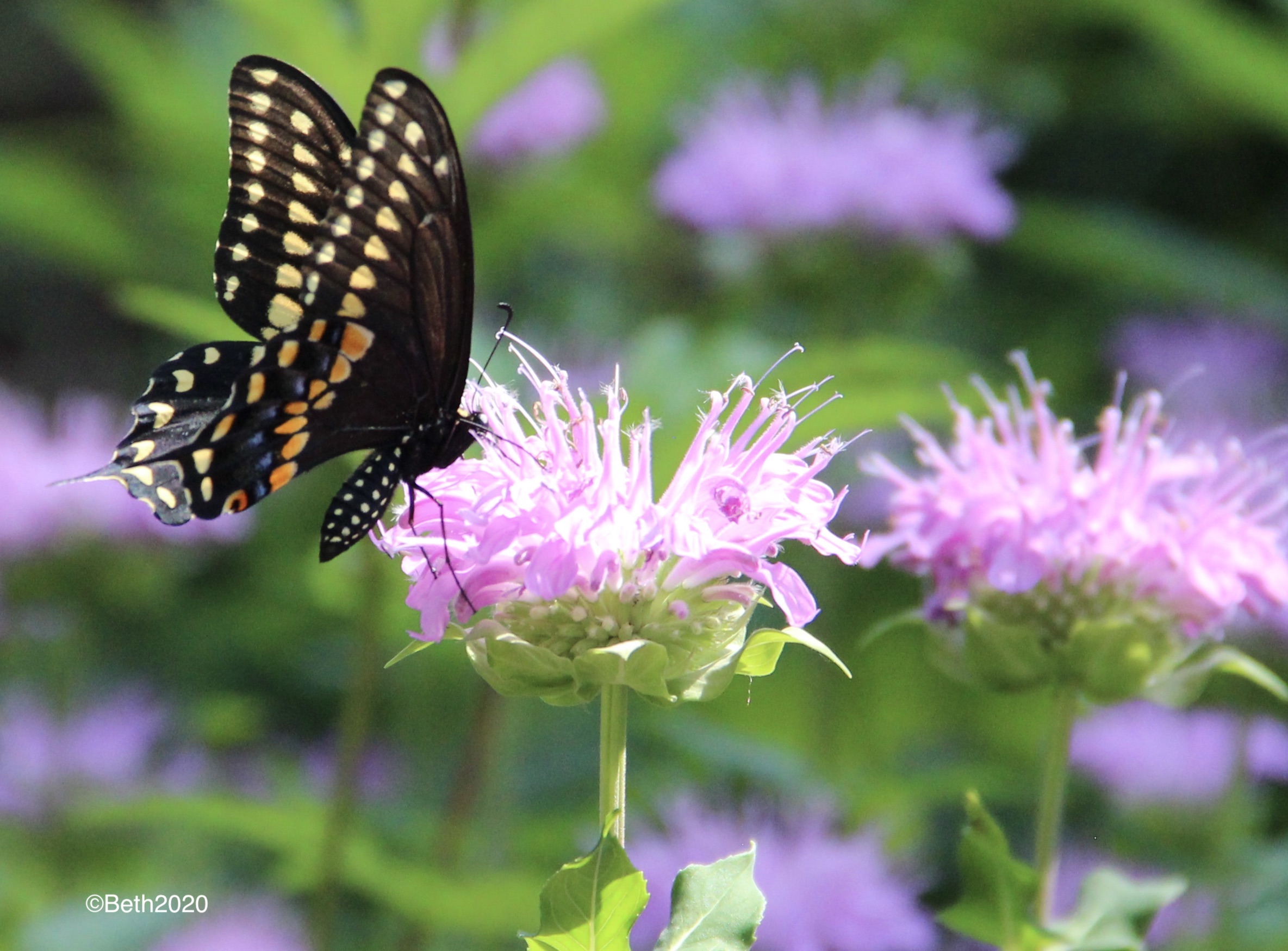
Two rows of yellow spots on the forewing distinguish the black swallowtail (Papilio polyxenes) from the eastern tiger swallowtail female dark form (Papilio glaucus).

This female monarch (Danaus plexippus) deposits an egg on the underside of a common milkweed leaf.

White admirals (Limenitis arthemis arthemis) are common in areas with aspen and birch. They prefer sap over flower nectar.

Red-spotted purples (Limenitis arthemis astyanax) are a southern subspecies of white admirals and the two often hybridize in the Upper Midwest. This one’s wings show that it has survived a bird attack.

Banded hairstreaks (Satyrium calanus) lay their eggs on oak trees. This adult rests on common milkweed in our garden.

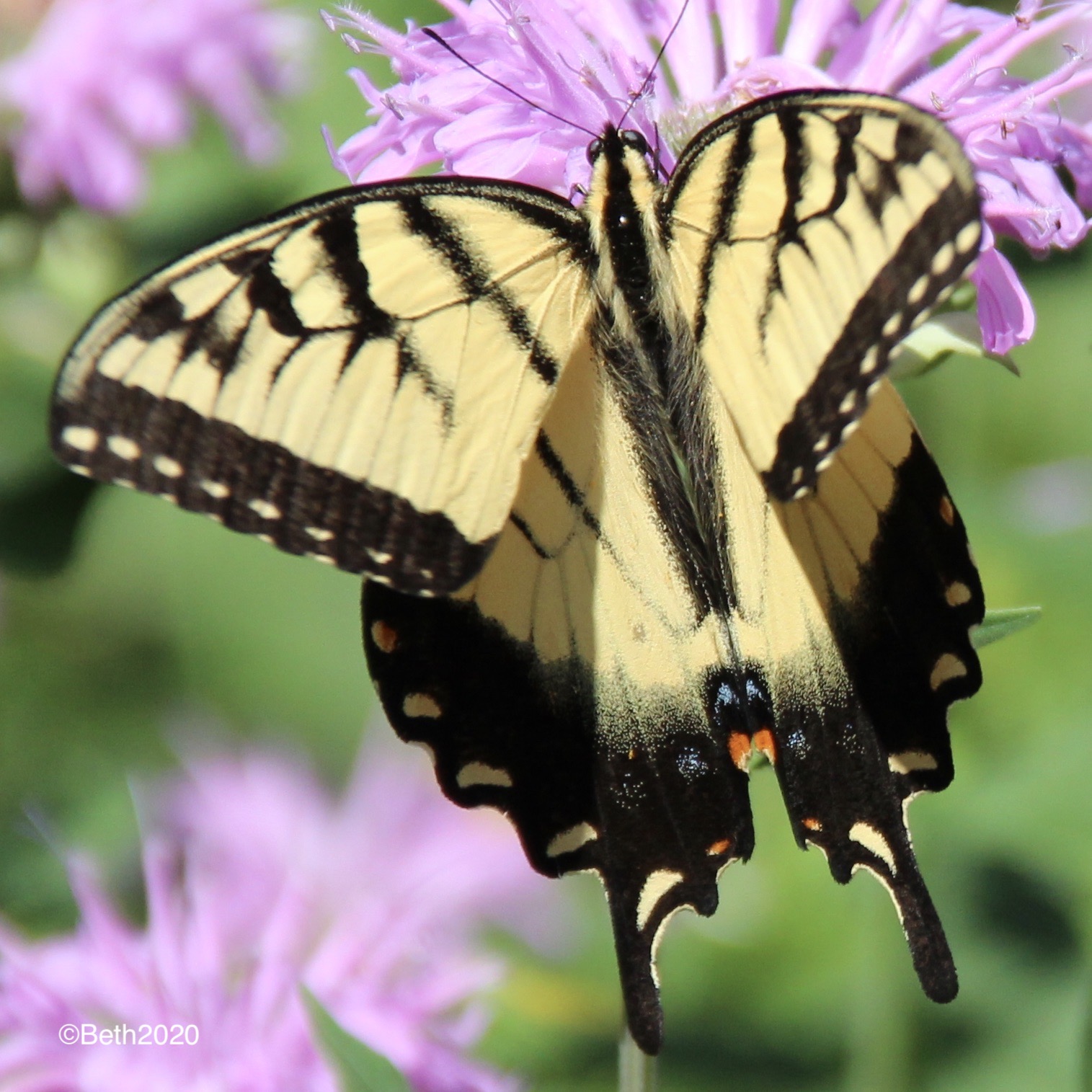
Eastern tiger swallowtails (Papilio glaucus) favor nectar from Joe-Pye weed, blazing star and phlox.

Red admirals (Vanessa atalanta) migrate north in April and usually depart in October. Their caterpillars feed on nettles.

Black Eastern Tiger Swallowtail

An eastern tiger swallowtail black form female nectars on nepeta ‘Walker’s low.’

It’s late spring with the entire summer ahead of us. Nature’s greens are deep and full. Tiger swallowtails (Papilio glaucous) are on the wing now, the first of two times during the Minnesota summer. The first flight is typically in May-June and the second in July-August. The offspring of the second flight overwinter in their chrysalides.

I watch a bright yellow male patrolling his territory, repeating the same route through the large silver maples across the alleyway, over our apple tree and under my neighbor’s birch tree. He is quick to give chase to other males that trespass.

Eastern tiger swallowtail males are always yellow with black stripes and lack the wash of blue on the hind wings.

On this sunny, breezy morning, a black form female nectars in a sea of blue nepeta in our front garden. Her iridescent blue-on-black wings flutter repeatedly from one end of the garden to the other. She is full of energy and free of wing tatters and tears.

The female’s underwings are marked with bright orange spots and light blue scales.

Most eastern tiger swallowtails in Minnesota are yellow with black stripes. However, the female is dimorphic, or appears in two forms: the familiar black-striped yellow and a rarer black form washed with shimmering blue across its hind wings. Faint black stripes are often visible on the dark female.

Just a tiny percentage of females appear in the black form, especially this far north, but are  common in the southern United States. Why? Scientists think that the black form is a mimic of the pipevine swallowtail, which tastes horrible because the caterpillars feed solely on pipevine plants. (Think of monarchs and viceroys, another example of mimicry. Birds hate the taste of monarchs because they eat milkweed. Viceroys closely resemble monarchs, so birds often avoid them.) Pipevine swallowtails occasionally come as far north as Minnesota.

Interested in attracting eastern tiger swallowtails to your yard or garden? Favorite caterpillar foods include: chokecherry, ash, poplar, maple, apple and mountain ash. Adults nectar on many flower species including phlox, milkweed, Joe-Pye weed, blazing star, bee balm/bergamot and red clover.

Salt Marsh Beauty

Native salt marsh grasses and pines. (All photos taken with iPhone XS.)

Beauty exists in Earth’s harshest places. On the Florida coast it’s easy to opt for a leisurely seashore walk and pass up a salt barren. Even the name sounds harsh, but these salt marshes, or salterns, along Florida’s West-Central Gulf Coast present their own simple beauty.

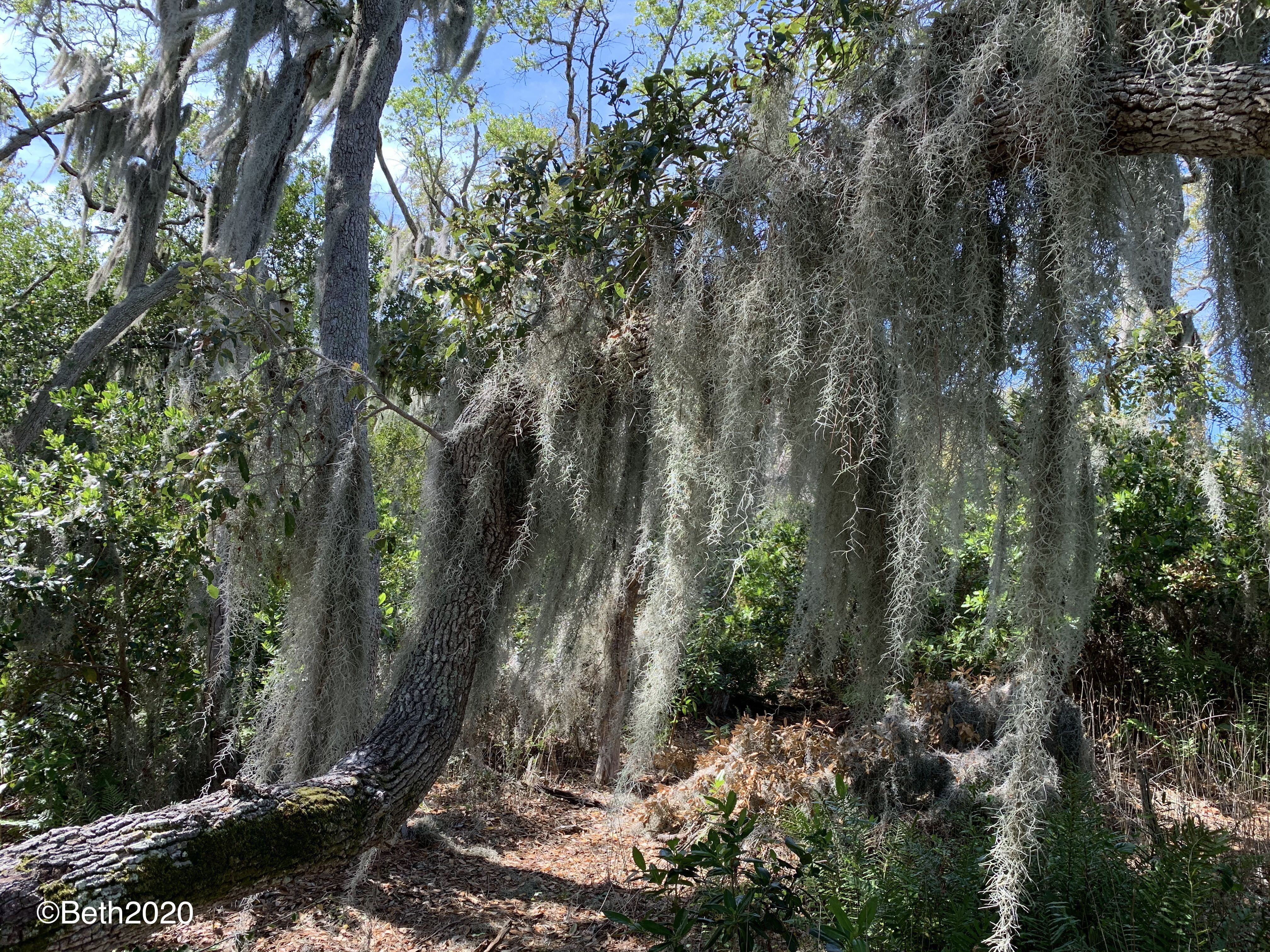
At first glance, I notice the Florida slash pines, longleaf pines and native grasses flowing low beneath an open sky. Closer to the water, seagrape, black mangrove and red mangrove grow. Songs of mockingbirds, mourning doves and northern cardinals blend with the swish of grass and pine needles. Delicate Spanish moss drapes many trees and billows in the unceasing wind. The birds quiet down in the late afternoon and leave a stillness so complete that I feel its weight — and relish it in these unsettling days.

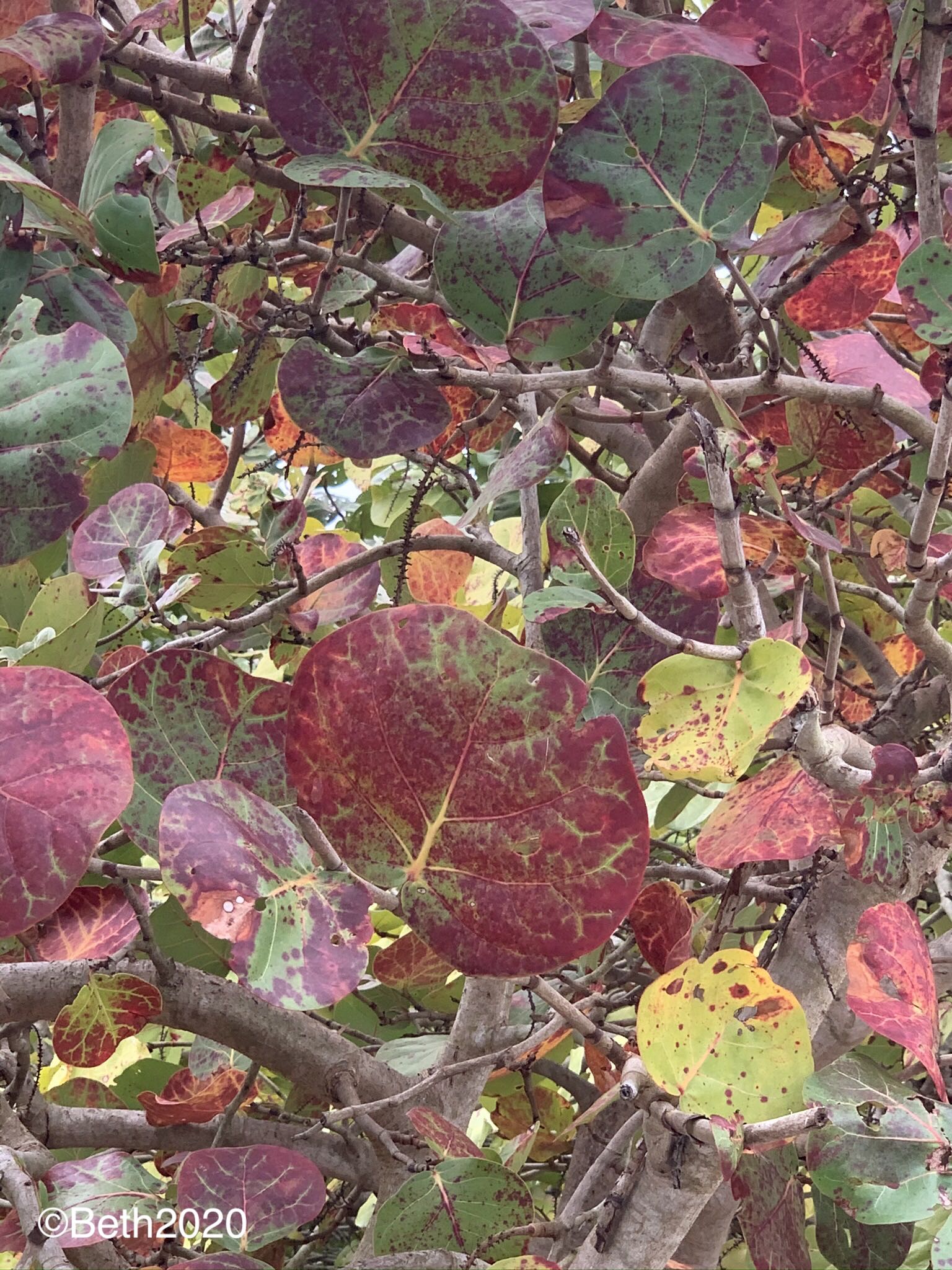
Seagrapes (Coccoloba uvifera) anchor the soil and produce a sweet fruit that makes a fine jelly.

Spanish moss (Tillandsia usneoides) is an epiphyte, or air plant, not a true moss. It often grows on cypress and oaks for support.

Wildflowers pop up in the dry, salty sand: sea purslane, sea oxeye daisies, sweetscent, coral bean, blanket flowers, dewberry, southern beeblossom, sea purslane, and even prickly pear cactus.

Sea purslane (Sesuvium portulacastrum) is highly salt tolerant and flourishes on the upper edges of salt marshes and coastal dunes. The holes visible above the blossom are fiddler crab homes.

Seaside oxeye daisies (Borrichia frutescens) are common in salt marshes and between mangrove swamps and coastal uplands.

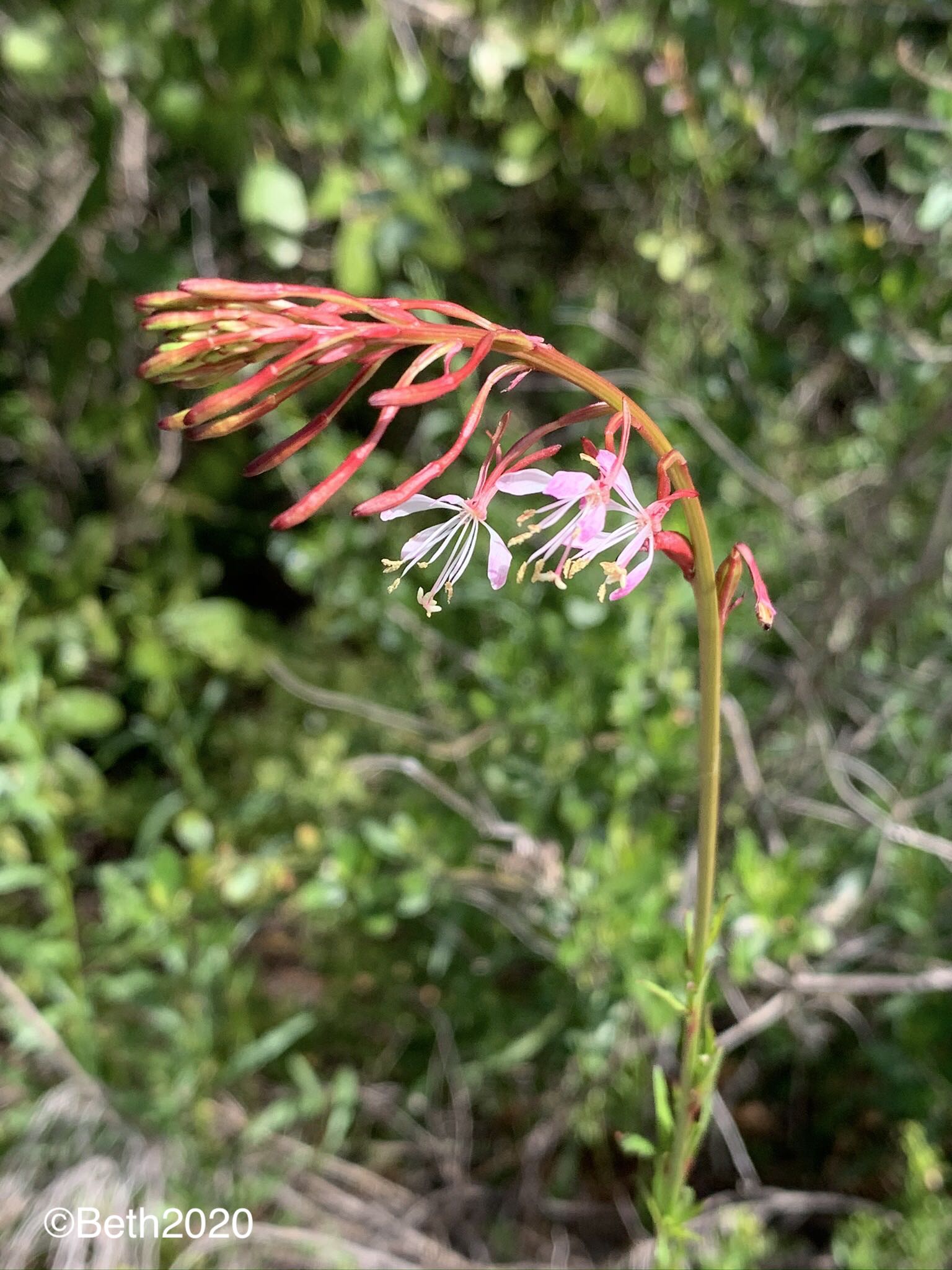
Southern beeblossom (Gaura angustifolia) flowers open white at night and turn pink the following day.

Southern dewberry (Rubus trivialis) is a cousin to the blackberry. It grows on the ground instead of upright.

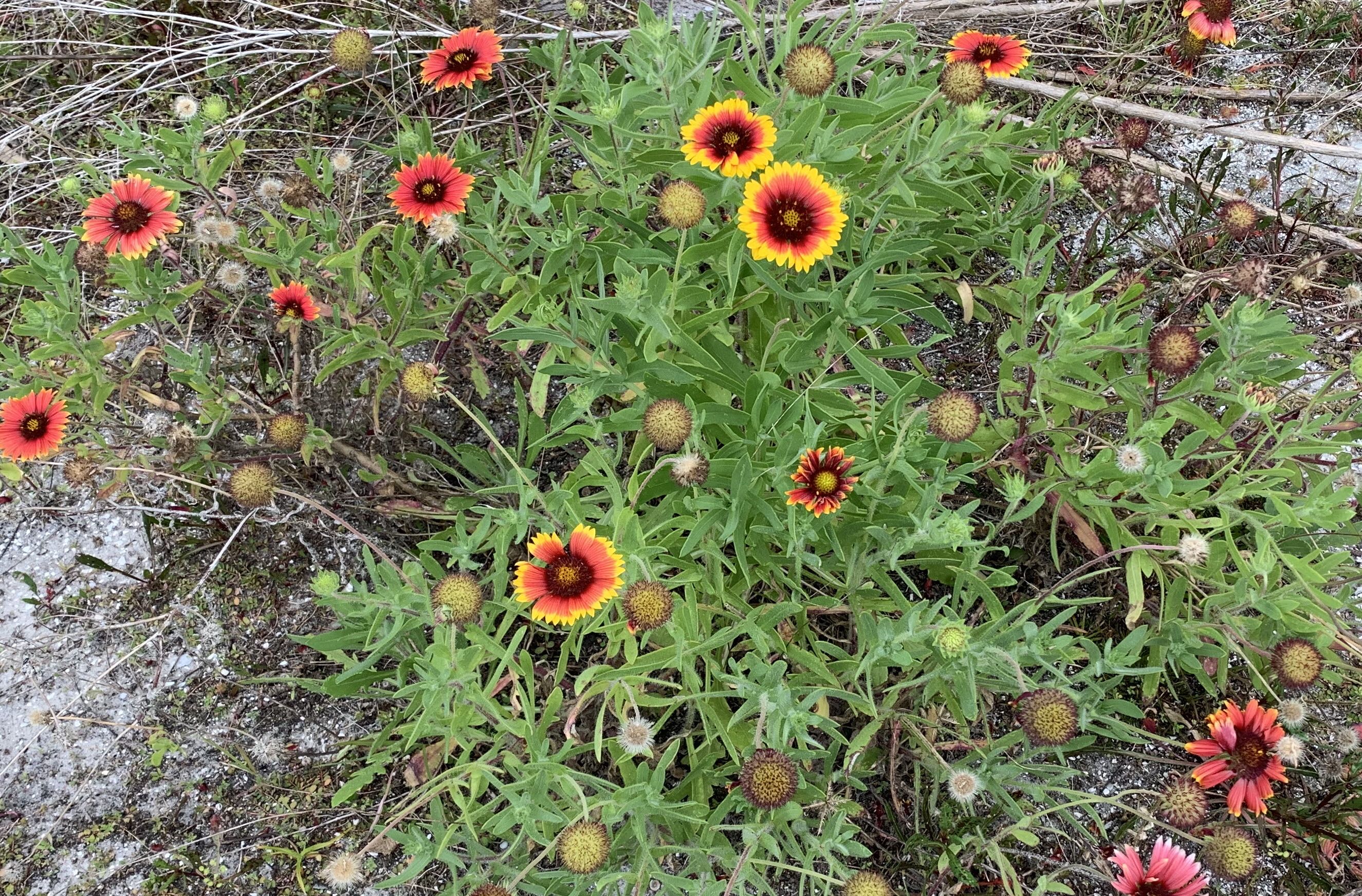
Native blankert flower (Gaillardia pulchella) prefers dry, sandy soil and tolerates salt well.

Prickly pears (Opuntia humifusa) are a major food source for gopher tortoises in the scrubland.

Sweetscent (Pluchea odorata) grows in salty habitats and attracts butterflies and bees.

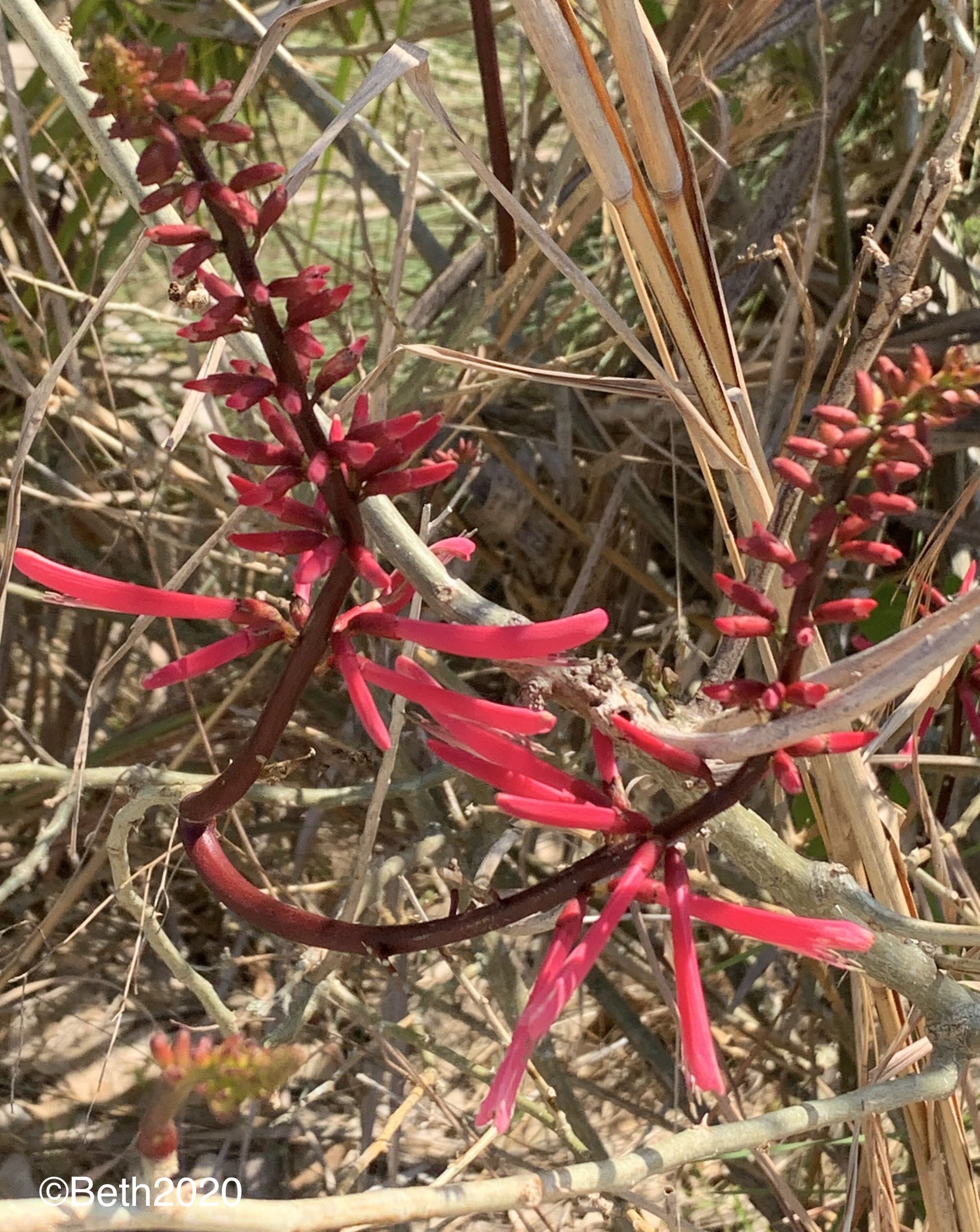
Coral beans (Erythrina herbacea) attract hummingbirds and bees.)

Ospreys circle overhead, little blue herons hunt in the mangroves, flocks of ibis gobble tiny crustaceans at low tide in the bayou and pelicans lounge in the marshes. A southern black racer snake darts across the sand path. We spot skinks, anoles and marsh rabbits. My favorite sightings are the zebra longwing, gulf fritillaries and queen butterflies nectaring in the wildflowers. Here are a few other photos from recent walks in the salterns.

American white pelicans (Pelecanus erythrorhynchos) feed in a shallow wetland near the marshes. (Watercolor by my husband.)

A little blue heron (Egrella cerulea) hunts for fish, frogs and small crustaceans in the mangroves.

The zebra longwing (Heliconius charitonius) is Florida’s state butterfly.

The queen butterfly (Danaus gilippus), a cousin to the monarch, also depends solely on milkweed for its nutrition.

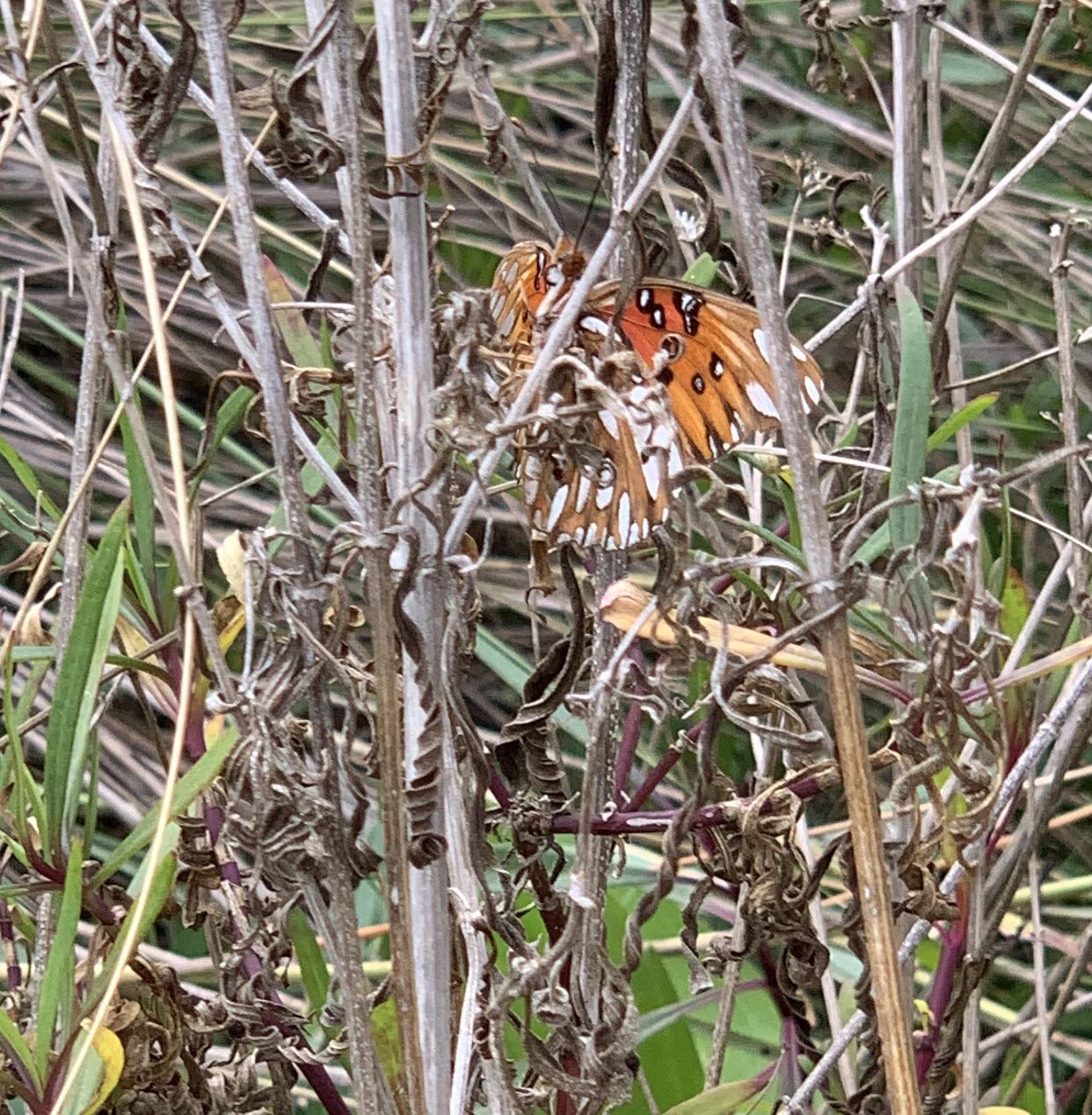
Gulf fritillaries (Agraulis vanillae) are active all year in south Florida.

saltmarshquiet

In the late afternoon, all is quiet. There is only the sun’s heat and the fullness of silence.


The Year’s First Monarch Caterpillar

This tiny monarch caterpillar is about 7mm long and is feeding on common milkweed.

I spotted my first monarch caterpillar (Danaus plexippus) of the season last week. I almost overlooked its tiny black, white and yellow striped body, which was about 1/4 inch, or 7mm long. It crawled slowly on a milkweed plant (Asclepias syriaca) where I saw my first adult monarchs of the year on June 3.

This tiny caterpillar faces many challenges on its journey to adulthood. In fact, fewer than 10 percent of all monarch eggs metamorphosize into butterflies, according to Monarch Joint Venture. Many garden critters prey on monarch caterpillars, especially parasitic wasps, tachnid flies, jumping spiders, the larvae of Asian ladybugs, and lacewing larvae. Most eat the caterpillars. Others, such as tachnid flies, lay their eggs on them. The eggs hatch and burrow into the caterpillar, which they use for nutrition and protection. It’s easy to dislike insects that prey on monarchs, but these predators also destroy many garden pests and are vital to the health of gardens and woodlands.

Weather conditions, food availability, pesticide use, damage from being stepped on or run over, and infection from bacteria and viruses also reduce monarch caterpillar numbers. The 10 percent that survive grow quickly on their milkweed diet and will molt five times over 9-to-14 days. Each stage between molts is known as an instar. The 5th instar usually leaves the milkweed plants in search of a safe place to form its chrysalis, where it completes the change to adulthood. The entire process from egg to adult lasts about one month.¹

Monarch caterpillars can be very elusive, but I’ll keep watching for them. In spite of predators, poor weather and other challenges, it’s likely that at least one or two will complete their journey to adulthood in our garden. They’ll pollinate many plants, lay eggs for the next generation of monarchs, and add beauty to our world.

An adult monarch nectars on Joe-Pye Weed (Eutrochium maculatum).

¹Three interesting resources about monarchs include Monarch Lab-University of Minnesota, Monarch Watch-University of Kansas, and Monarch Joint Venture.

Garden Bugs: Nifty or Nasty?

Like most of life, my garden is a mix of good and not so great: desirable plants and weeds, loamy soil and heavy clay, beneficial insects and annoying pests — and early August brought many types of insects to our garden. Here are just a few stand-outs.

Japanese beetles (Popillia japonica), an invasive species, are a type of scarab beetle that destroy many plant species in North America.

The biggest pest in our yard is the Japanese beetle, which skeletonizes the flowers and leaves of many plants. A few weeks ago they favored apple and crabapple trees, but I’ve also pulled them off of my rose, asters, day lilies and purple coneflowers. Now, they are shredding my hosta and anise hyssop blossoms. According to the Minnesota Department of Natural Resources, the beetles are native to northern Japan and probably arrived in a shipment of iris bulbs in 1916. They have no natural predators, although some birds, such as starlings, robins, bluejays and sparrows will sometimes eat the adult beetles and the grubs, which live in lawns.

Yesterday I picked 46 beetles off of my royal standard hostas. I used to squish them, but that releases their pheromones, which attract more beetles. Now I pick them off by hand and drop them in a small pail of soapy water, which kills them quickly without releasing their pheromones. I don’t use an insecticide because so many beneficial insects would die from the chemicals.

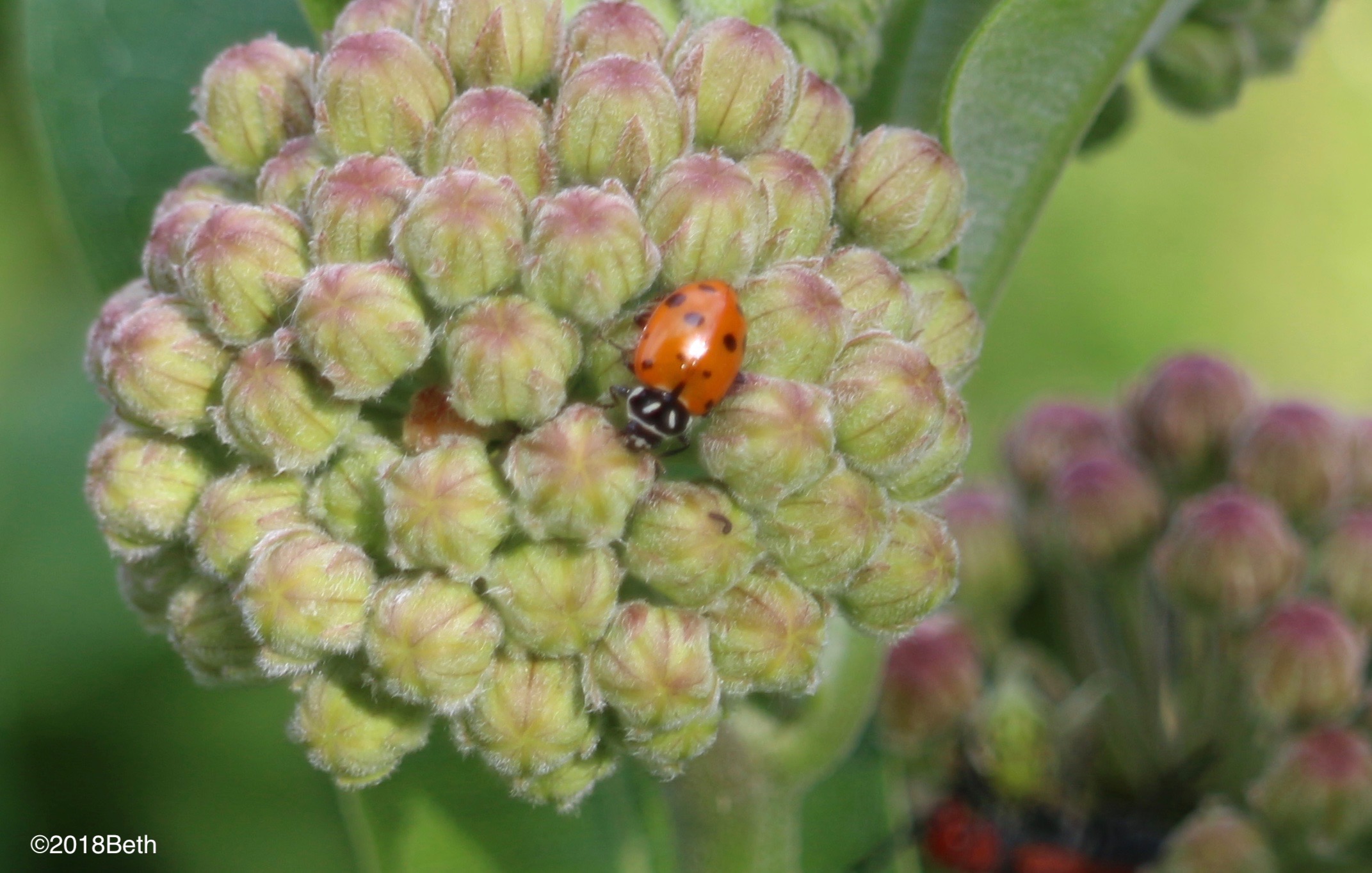
The convergent lady beetle (Hippodamia convergens) is a North American native that feeds on aphids, whiteflies and other pests.

Not all ladybugs are red or orange. The tiny esteemed ladybug (Hyperaspis proba) is black with yellow spots.

Unlike the Japanese beetle, ladybugs, or ladybird beetles, especially those native to North America, are beneficial to gardens. More than 500 species of ladybugs have been identified in the United States. Mom taught us never to harm ladybugs because they eat aphids, a major garden pest. Our native ladybugs don’t bite, so if you feel a pinch and find it’s from a ladybug, it is likely to be an Asian ladybug, which do nip — mainly because they seek moisture and salt, or they feel threatened. Asian ladybugs were imported in the 1970s to help destroy predators in agricultural operations. I let them be when I find them because they destroy so many aphids and other pests. However, the native ladybugs are better suited to our gardens and plant species.

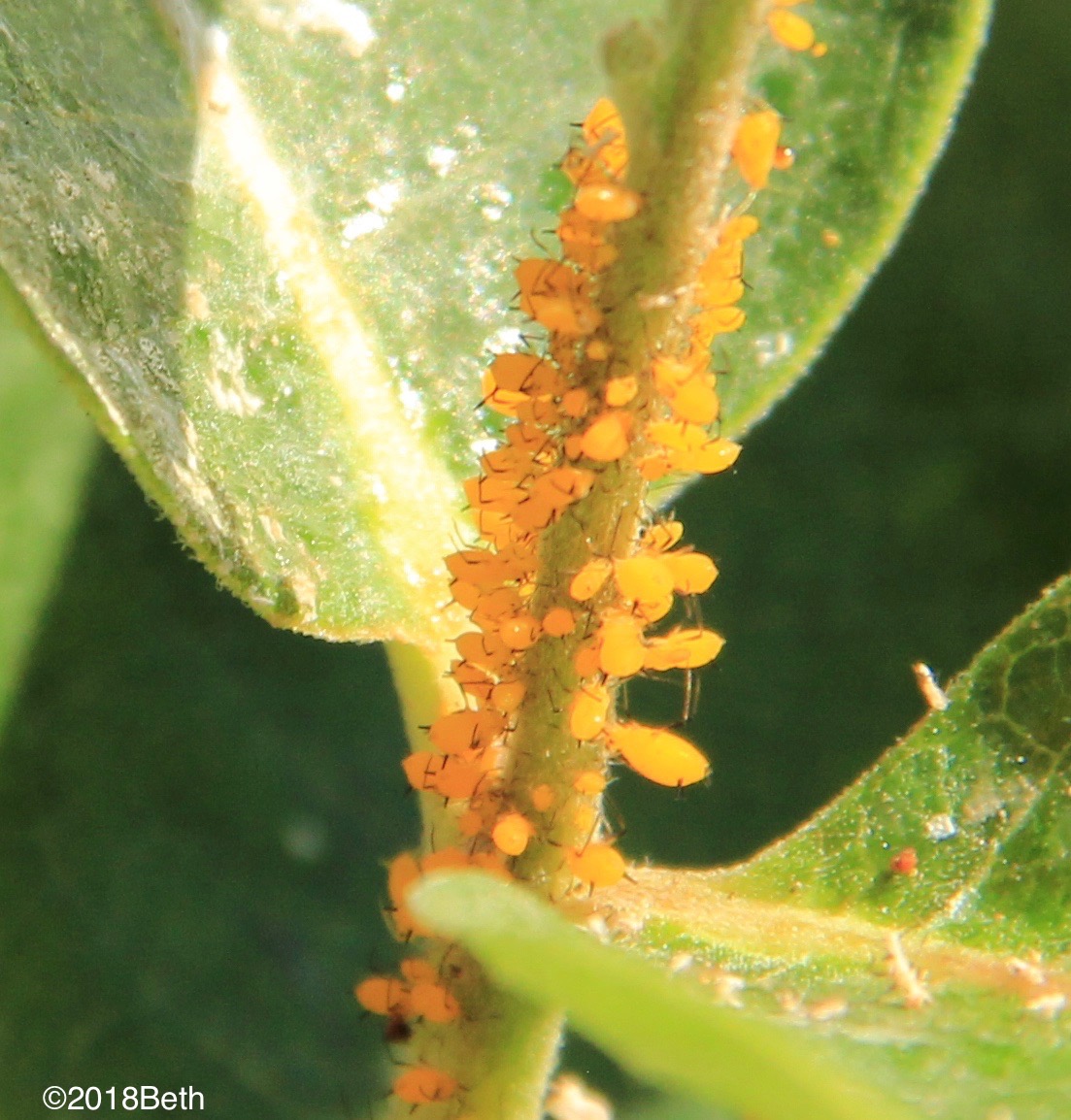
Aphids, that favorite food of ladybugs, are tiny, often wingless, and very plentiful. There are more than 300 species of aphids in Minnesota and they are found on all types of plants. Most aphids on a plant are females that reproduce asexually, without having to mate. They also give birth instead of laying eggs. The newborns are clones of their mother, so they, too, are female. (Environmental conditions sometimes cause females to produce both female and male offspring, which are genetically identical to the mother, except that males lack one sex chromosome.) They come in many different colors. I’ve seen green, black, red, and I have orange ones on some of my milkweed plants. When aphids suck a plant’s sap, it causes curling, yellowing and browning of the leaves. Aphids also secrete a sticky, sweet liquid called honeydew. Last summer, during a heavy infestation of aphids, my milkweed plants were dripping with honeydew and covered with ants, which are attracted to the sweet liquid. Even though I washed the milkweed with water from the garden hose daily, the plants were disfigured and messy.

Tiny soft-bodied aphids (Aphids nerii) suck plant juices from common milkweed. The white specks are moltings that are stuck in the honeydew.


This juvenile male eastern pondhawk (Erythemis simplicicollis) will attack any type of insect its own size or smaller, including others of the same species.

In contrast to the slow, rather clumsy flight of beetles, several species of dragonfly dart and swoop among the garden plants. Perched on a milkweed leaf, a green eastern pondhawk zips lightning-quick from its perch to capture a fly. Its powerful jaws quickly crush and consume its prey. Common in gardens, dragonflies eat mosquitoes, gnats, flies and other insects. Their shining colors add beauty to the garden.

Most meadowhawks (Sympetrum spp.) fly in late summer and autumn.

Monarchs, red admirals and other butterflies are frequent visitors to our garden — especially now when the milkweed is blooming and the plants are in their prime for feeding monarch larvae. These tiny caterpillars feed only on milkweed and I discovered two of them a week ago. Adult monarchs sail through the garden stopping to nectar on milkweed, Joe-Pye, garden phlox and purple coneflowers.

Monarch caterpillars hatch and grow only on milkweed plants.

Adult monarchs (Danaus plexippus) and many other butterfly species nectar on common milkweed (Asclepias syriaca).

A red admiral (Vanessa atalanta) nectars on garden phlox (Phlox paniculata).

Red admirals are smaller and fly faster and more erratically than monarchs. A male finds a sunny spot and watches for a female to fly by. After mating, the female lays eggs on nettle plants. Adults nectar on milkweed, red clover, ripe fruit and tree sap. They are one of the few species that overwinter in Minnesota, often in a wood pile or mound of leaves.

The summer garden harbors so many interesting, and often beautiful, insects. Next time you’re working in your garden, or simply enjoying your yard, take a look at the diversity of these tiny creatures all around us. The majority of them are either beneficial or harmless. Nifty or nasty? You decide!

Winged Beauty

The numerous blue scalings along the wing border identify this as an eastern tiger swallowtail female (Papilio glaucus).

Just before supper on a hot August evening, the air is heavy with smoky haze from Canadian forest fires. I hear the constant whine of cicadas and smell the scents of garden phlox and royal standard hostas. In a corner of our garden a creature of great beauty nectars in the Joe-Pye; its striped wings open and almost glow against a background of green leaves and shades of pink. The deep blue spots lining its hind wings reveal it to be a female eastern tiger swallowtail. She’s oblivious to the numerous bumblebees that gather nectar and pollen around her. At one point a territorial monarch chases her from the Joe-Pye. (The monarch repeats its rounds through the yard many times an hour, and tries to oust “intruders” — especially other large butterflies.) The two dance a quick scuffle in the air and the “tiger” disappears over the neighbor’s fence for a few minutes. She soon returns to the Joe-Pye garden and continues to nectar.

Joe-Pye (Eutrochium maculatum) is a favorite source of nectar for eastern tiger swallowtails.

I like to recall such moments of warmth and beauty in January and February as I mark off the days on the calendar and wait for spring. I’ll think of the gentle humming of bumblebees, the lilting call of a goldfinch passing by, and the delicate, colorful wings of all of the butterflies that sail through the garden, especially the tiger swallowtail. I’ll remember that her progeny will overwinter in chrysalis form — attached to tree bark, a plant stem, or in leaf litter — snug and asleep under the snow. In May, they will hatch to continue their life cycle of beauty.

A Present Moment

A male eastern tiger swallowtail (Papilio glaucus) butterfly.

Our native monarda begins to bloom. One early-July afternoon, I read in the garden for a few minutes. It is so quiet with most of the neighborhood out-of-town for July vacations — I hear just the rustling of leaves and flowers in the breeze and a few mourning doves calling. A male eastern tiger swallowtail nectars in the monarda, and is so intensely focused on the blossoms that I walk right up to him with my camera. His wings are radiant yellow and unmarred, showing no signs of wear or age. The yellow glows when he dips into the shadows, and the scallops under his wings are vibrant orange and steely blue.

Underwings of an eastern tiger swallowtail on monarda or bergamot.

Though he ignores the company, three red admiral butterflies and several bumble bees busily nectar in nearby blossoms. They, too, are absorbed with collecting nectar and are oblivious of each other and of me.

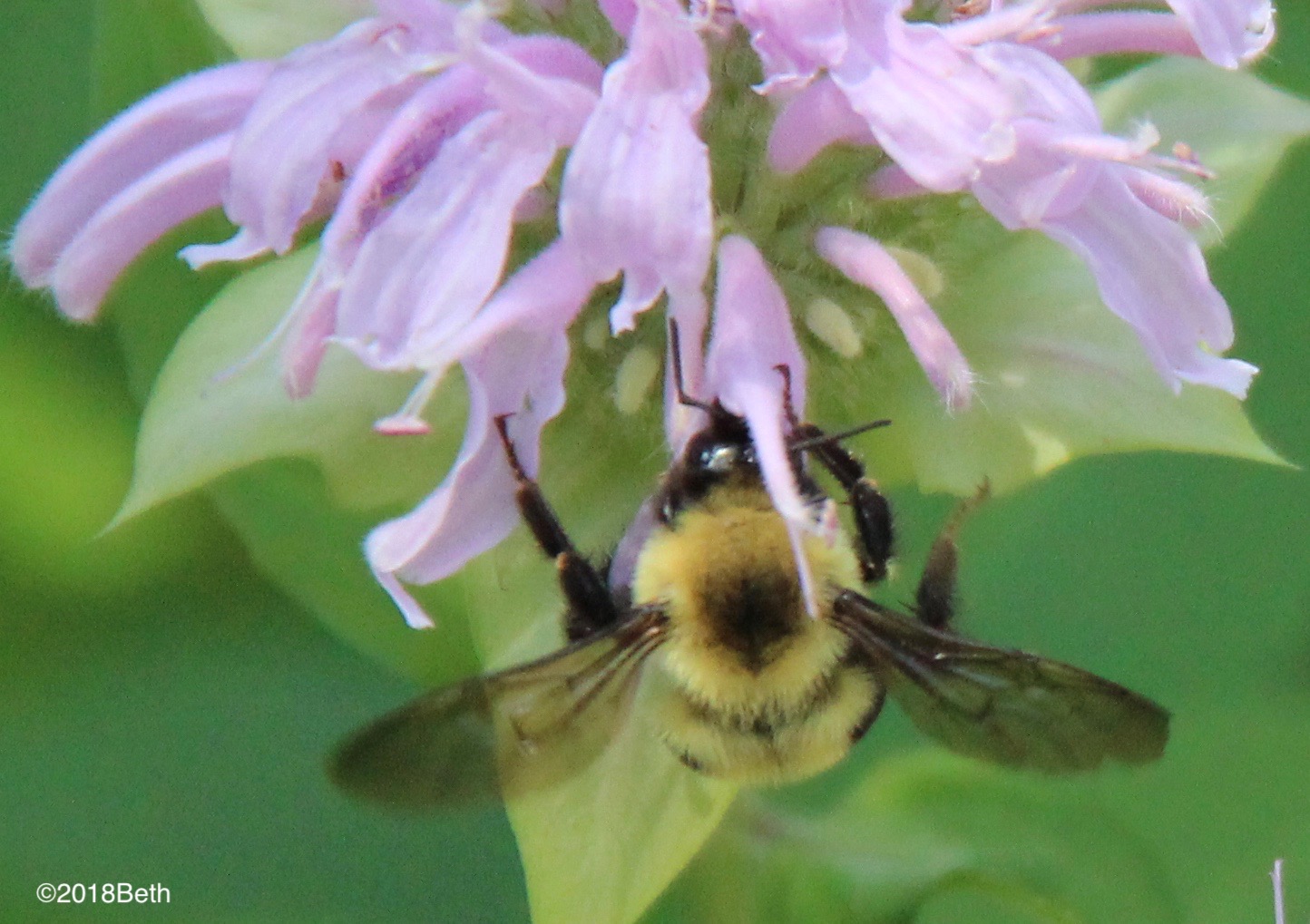
Bumble bees (Bombus spp.) love the nectar of monarda blossoms.

Red admiral butterflies (Vanessa atalanta) visit gardens from April through October before migrating south.

This peaceful time on a warm summer afternoon is, for me, an active meditation on living in the present moment. It is a gift to share this time and space with such lovely creatures; to put aside frets and worries, to let go of the past and future; to just be in this one moment.