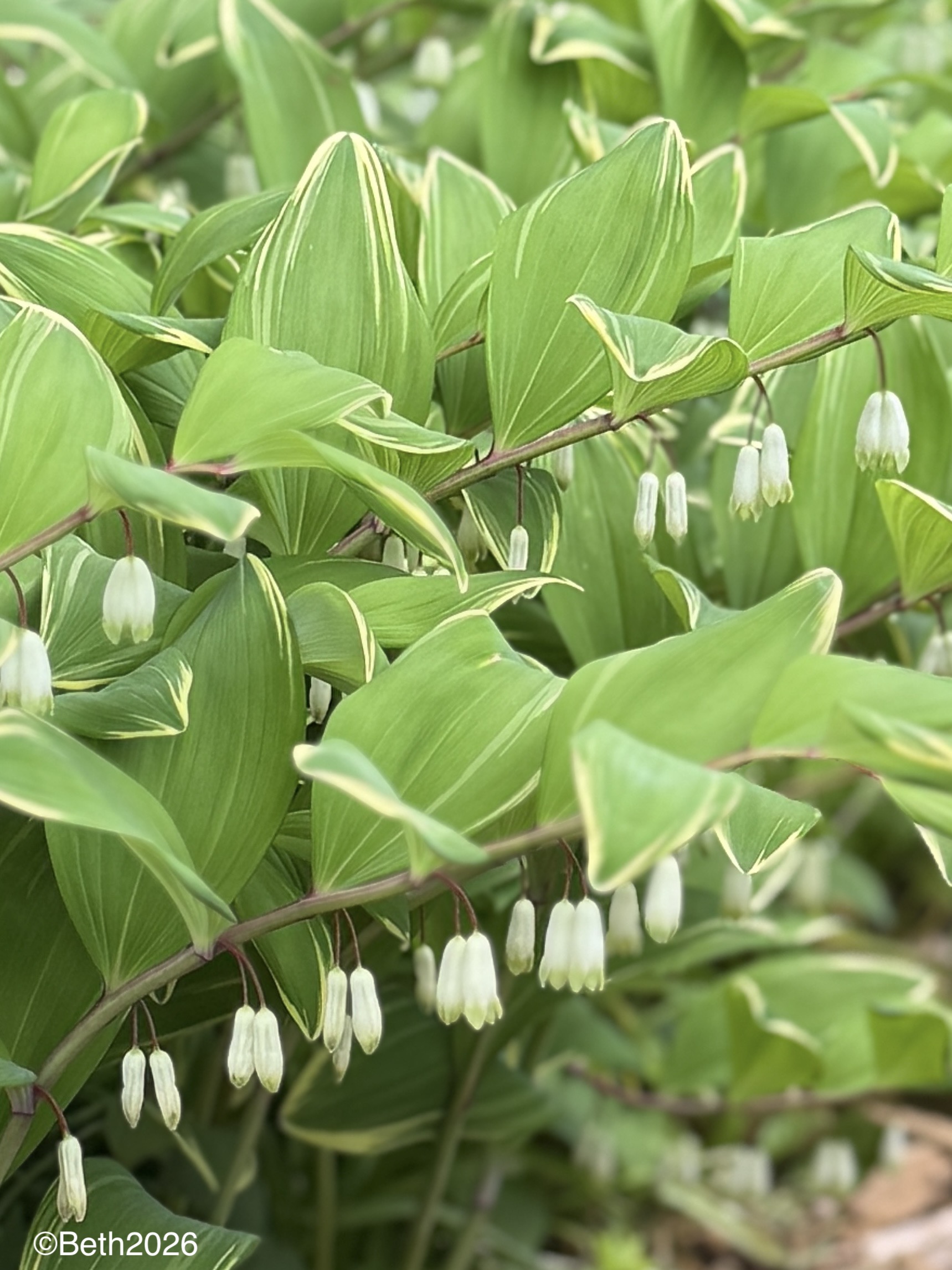
Solomon’s seal (Polygonatum odoratum variegatum) form colonies in open woodlands and shade gardens.
Like tiny pairs of bells, the flowers of Solomon’s Seal hang beneath arching branches, softening the landscape of open woodlands and shade gardens in May and June. Solomon’s Seal (Polygonatum biflorum) is one of my favorite spring wildflowers. I was intrigued by the plant’s name when I first spotted it growing in the open deciduous woods at our cabin in East Central Minnesota.
How did it get its name? It refers to the rhizome, or underground stem, seen by few unless it’s dug up. (I’ve never seen it myself, but it is described as being rough and knobby.)
When each year’s stem dies back, it creates a circular scar with markings that supposedly reminded observers of seals used by royalty in ancient times. Why it was named after King Solomon isn’t clear. A closely related plant, Polygonatum odoratum, is native to the Middle East. (We plant it in our gardens today.) Legend has it that the rhizome’s scars resembled Hebrew letters and reminded people of the seals used on royal documents. They named it after King Solomon to honor his wisdom and ability to heal.
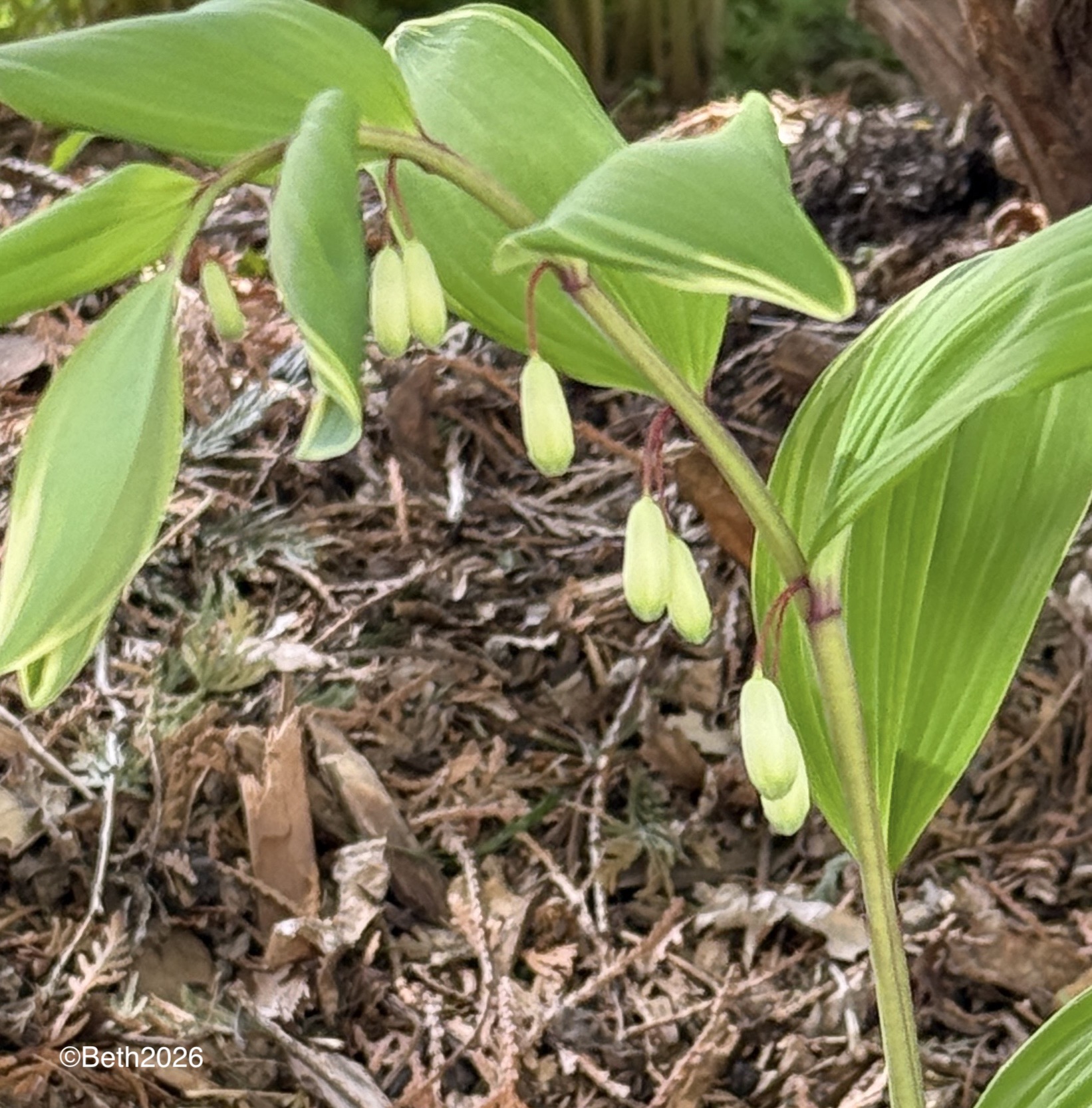
Flower buds of Solomon’s seal will open into paired bells on slender maroon stalks.
Whether or not it’s a plant of legend, Solomon’s Seal is an important member of deciduous woodlands and shade gardens. In its native form, P. biflorum grows in Eastern North America from Saskatchewan to the Atlantic Ocean, south to Florida and west to Texas. Graceful, arching stalks and oval-to-lance-shaped leaves and berries are highlights. Leaf color is a bright lime-to-medium-green surface with whitish or pale green below. In May and June, long rows of delicate ivory-green flowers hang beneath the leaves and look like pairs of tiny bells. Bumblebees and many other species of native bees collect nectar and pollen from them.
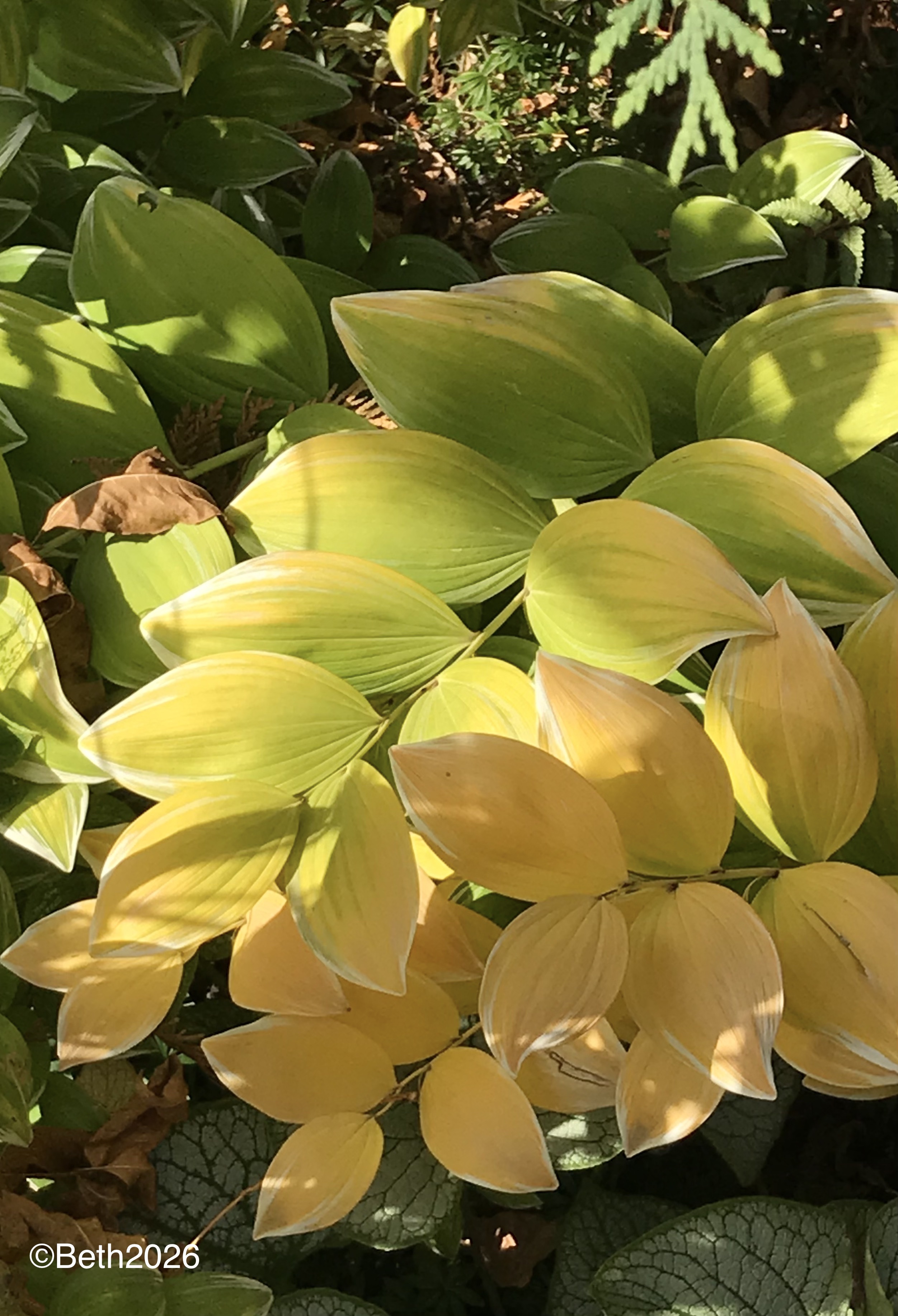
In autumn, leaf color softens from bright green to lemon yellow, gold and light brown.
In early autumn, green berries ripen to blue-black spheres beneath the leaves. The berries are toxic to humans, but are a delight for birds, especially members of the thrush family, such as American robins, bluebirds and veeries. (Our berries are always eaten while they’re still green!) Leaves morph from green to lemon yellow and gold before drying to brown.
Hairy Solomon’s seal (Polygonatum pubescens) is similar to P. biflorum, with the addition of fine, short hairs that grow along the underside of the leaf veins. It’s also slightly larger and has larger flowers than P. biflorum. Both grow well in shade/partial shade gardens. They prefer moist, rich soil, but will also tolerate dry conditions. Both varieties grow well in eastern North America, primarily in USDA and Canadian hardiness zones 3-8 and 3a-8b respectively.
Indigenous peoples used Polygonatum in medicine and cooking. The rhizome was ground up and used as a poultice for wounds and bruises, and as an anti-inflammatory agent to treat a variety of respiratory, digestive and connective tissue problems. It was cooked and eaten similar to a potato and also was ground up to make flour.
Polygonatum odoratum, which is native to Eurasia, is a popular garden plant, especially P. odoratum variegatum. The leaves are egg-shaped, and variegated in icy green and ivory. When the shoots emerge and begin to unwrap in early spring, they are often streaked with pale pink, as are the early leaves.
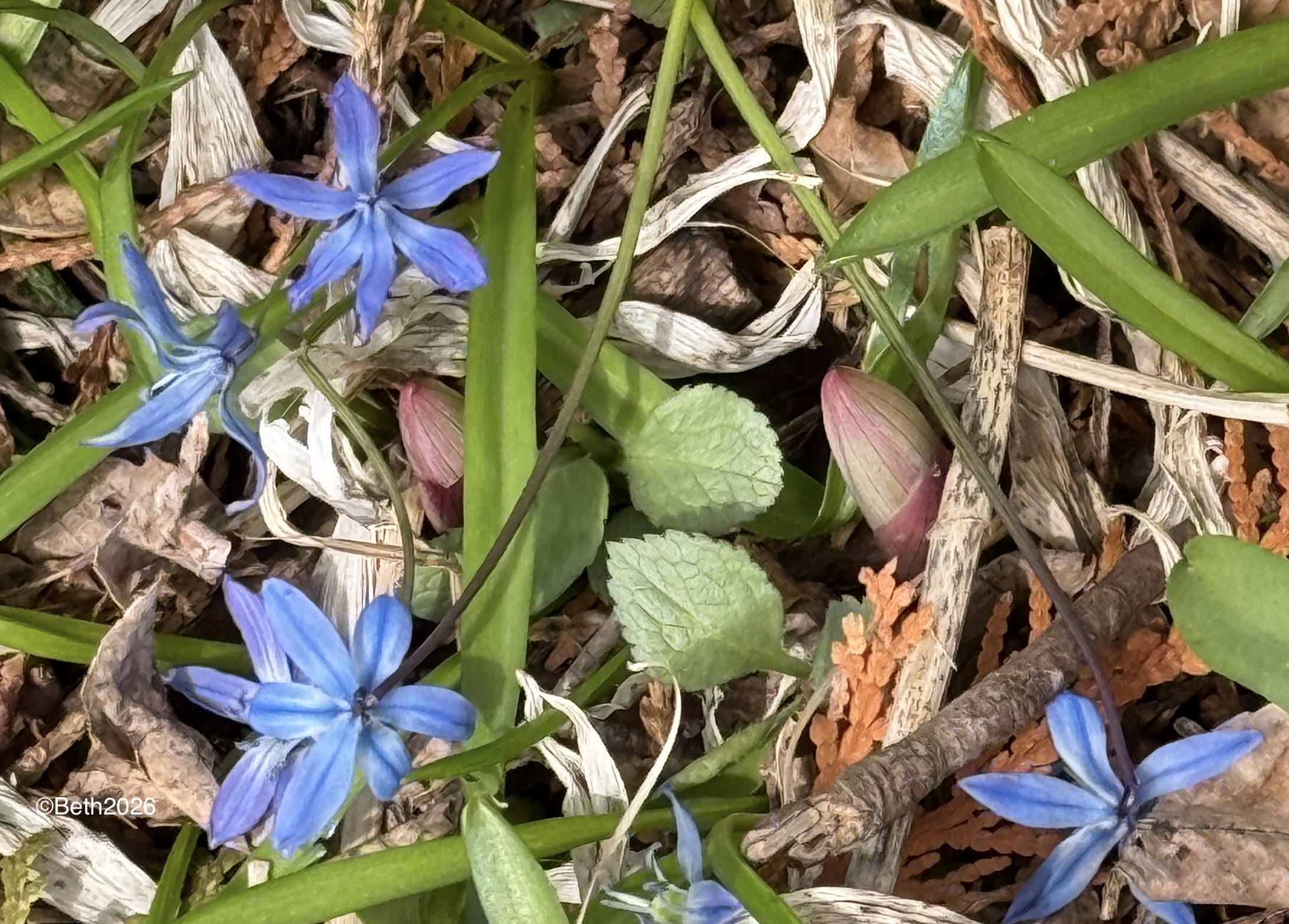
The emerging tips of variegated Solomon’s seal are streaked with light pink.
In my partial sun/shade garden, I grow P. odoratum variegatum (USDA/Canada hardiness zones 3-9/3b-9a) with sweet woodruff, wild geranium, painted ferns, ghost ferns, Canada wild ginger and in one area of the garden, with a selection of variegated hosta.
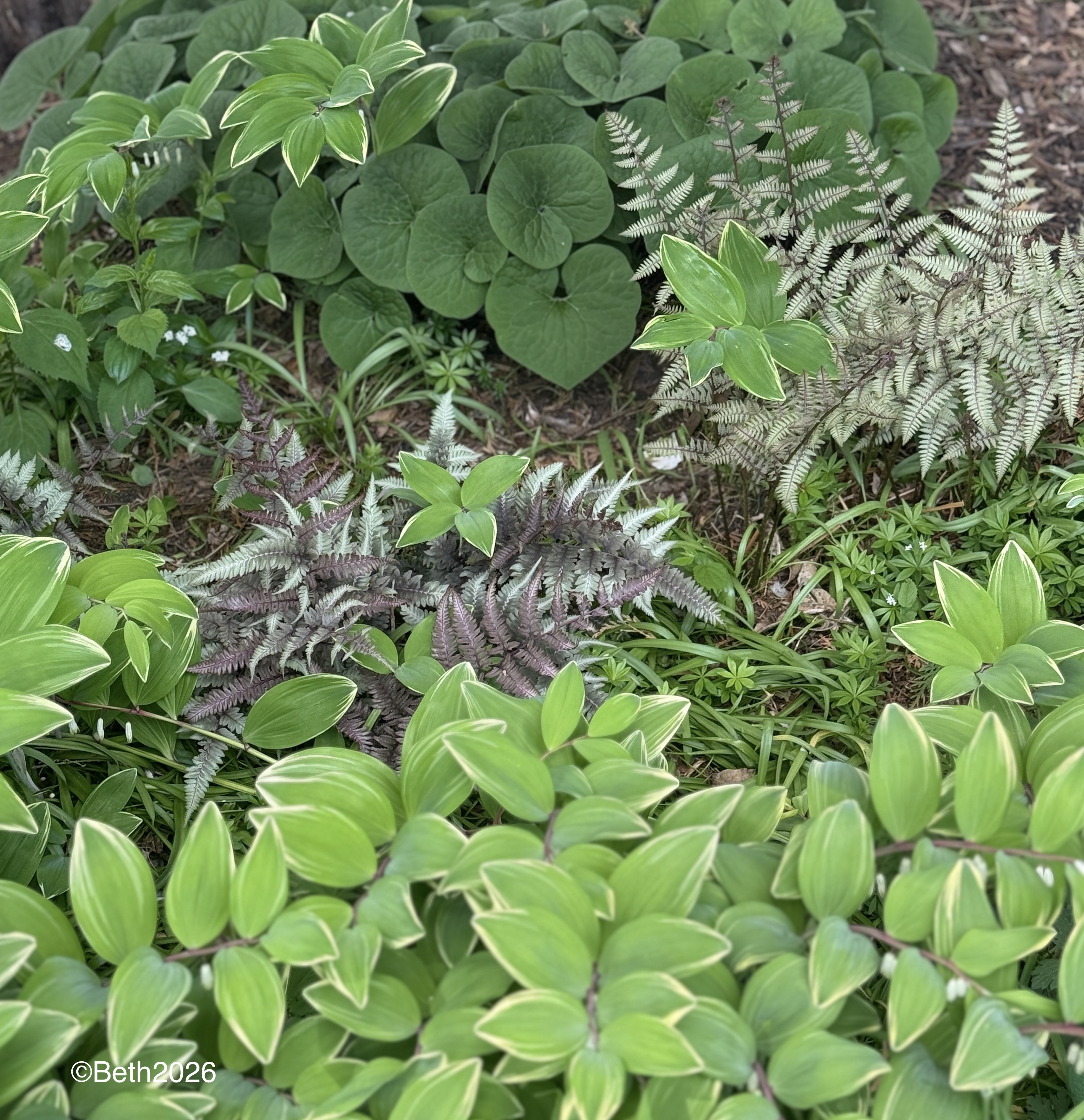
Variegated Solomon’s seal grows well with ferns, wild Canada ginger and sweet woodruff in my shade garden.
Sources and Further Reading
Eloise Butler Wildflower Garden (This website features excellent photos of all parts of each plant.)
Missouri Department of Conservation
Sanders, Jack. (2014). The Secrets of Wildflowers: A Delightful Feast of Little-Known Facts, Folklore and History. Guilford, Connecticut: Lyons Press, Pp. 80-82.