Bottle Gentians

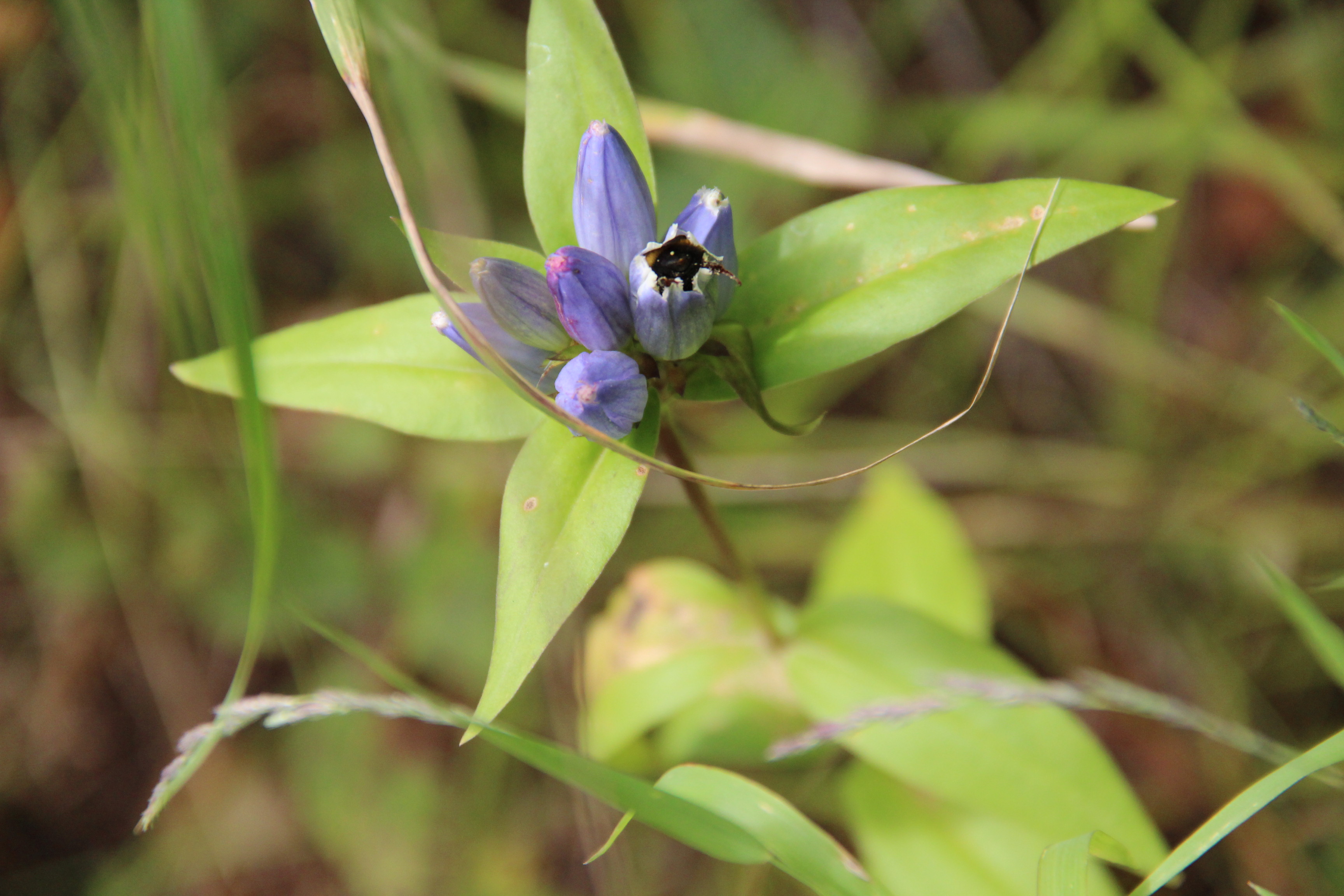
One of my favorite late-summer wildflowers is the bottle gentian (Gentiana andrewsii), which grows in sunny, moist patches along the dirt road next to our cabin.  The tightly closed oval flowers, which never open into a blossom, are all deep blue so far this year, but in the past, I’ve also seen powder blue, pearly white, and light pink blooms.  The plants are about 18 inches tall and the flowers are clustered together at the top.

Bottle gentians grow in sunny, moist patches.

Bottle gentians grow in sunny, moist patches.

Because the blooms are narrow and closed, they primarily are pollinated by bumble bees, which are strong enough to wiggle their way into the flower.  A bumble bee pollinated several of the blooms on the bottle gentian that I was photographing.

A bumble bee pushes its way into the closed bloom.

A bumble bee pushes its way into the closed bloom.

After pollinating the gentian, the bumble bee backs out of the bloom.

After pollinating the gentian, the bumble bee backs out of the flower.

Monarchs and Joe-Pye Weed

Monarch butterflies are rare visitors this summer.  In a typical year, they float through the backyard all day.  Over the past week, a solitary monarch visited our patch of spotted Joe-Pye weed (Eutrochium maculatum) each day between 7 and 8 a.m.  Sunlight glowed in its beautiful wings as it sipped the Joe-Pye nectar.

A monarch sips Joe-Pye weed nectar in early-morning sunlight.

A monarch sips Joe-Pye weed nectar in early-morning sunlight.

In the next two weeks, monarch migration through St. Paul, MN, should peak, according to MonarchWatch.org.  To check peak migration in your own area, visit  peak migration.  During the 2011 fall migration peak, 10-to-25 monarchs visited our Joe-Pye patch each afternoon, and often roosted in our apple tree for the night.  I’m interested in comparing this year’s numbers with the 2011 observations.  (Last year, the Joe-Pye blossomed two-to-three weeks earlier than usual, due to the early spring, and as a result, finished blooming ahead of monarch migration.

In addition to the low numbers of monarchs, I’ve only seen one each of black swallowtails, red admirals and mourning cloaks, and only two tiger swallowtails in our garden.  I haven’t found caterpillars of any of the five species.  Read more about the low number of butterflies this year, from the Star Tribune.

On the Banks of the Snake River (St. Croix Basin)

It’s a breezy, clear, mid-August morning at the Snake River in east central Minnesota.  An old silver maple creeks in the wind and a pileated woodpecker’s call rings through the woods.  Trees, thickets and river grasses show lush shades of green.  I am so glad to see no hint of autumn in them yet. But, other plants tell a different story.  The berries of false Solomon’s seal grow red, chokecherries and currants ripen to purple, and hawthorne fruit and wild rose hips begin to blush.  Hickory and hazelnuts are plump and the fragrant basswood flowers of a few weeks ago are now little round nutlets.

False Solomon's Seal Berries

False Solomon’s Seal Berries

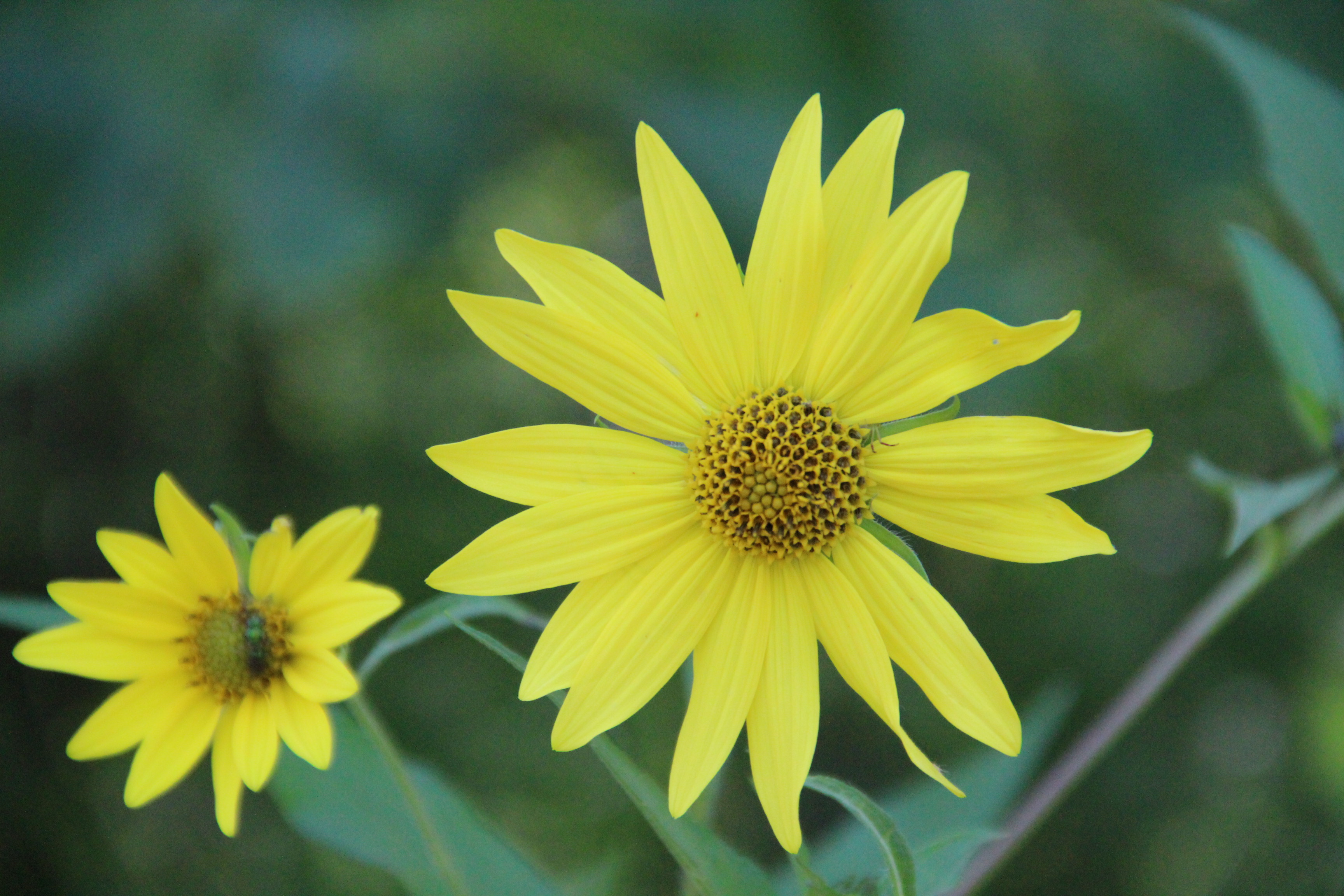
Flowers are changing too.  Turk’s-cap lilies, meadow rue and vetches have been replaced by woodland sunflowers and lesser purple fringed orchids.  The first goldenrod buds are turning yellow, and harebells and heal-all continue to bloom.
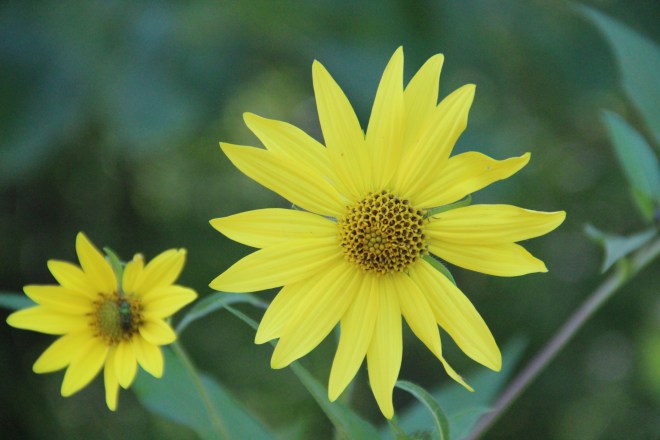
Woodland sunflower

Woodland sunflower

IMG_3378

Lesser purple fringed orchid

The woods are much quieter than in July.  Most birds have finished breeding and their babies have grown, putting an end to the feeding frenzy.  I miss the morning and evening chorus — especially the ethereal vespers sung by the wood thrushes.  Fortunately, the last few mornings, a family of five blue jays visited our hazelnut thicket.  They call softly to each other as they pluck the nuts, hold them against a tree branch and peck open the husk.  These jays are more elusive than the jays in our city yard.  They retreat deeper into the woods when I sit outside and try to photograph them.

In the late afternoon, a lone cicada buzzes.  Grasshoppers and crickets trill softly and are joined by snowy crickets and katydids in the evening.  Their night music, though simpler than birdsong, complements the burble of river water over rocks and gently soothes as darkness falls.
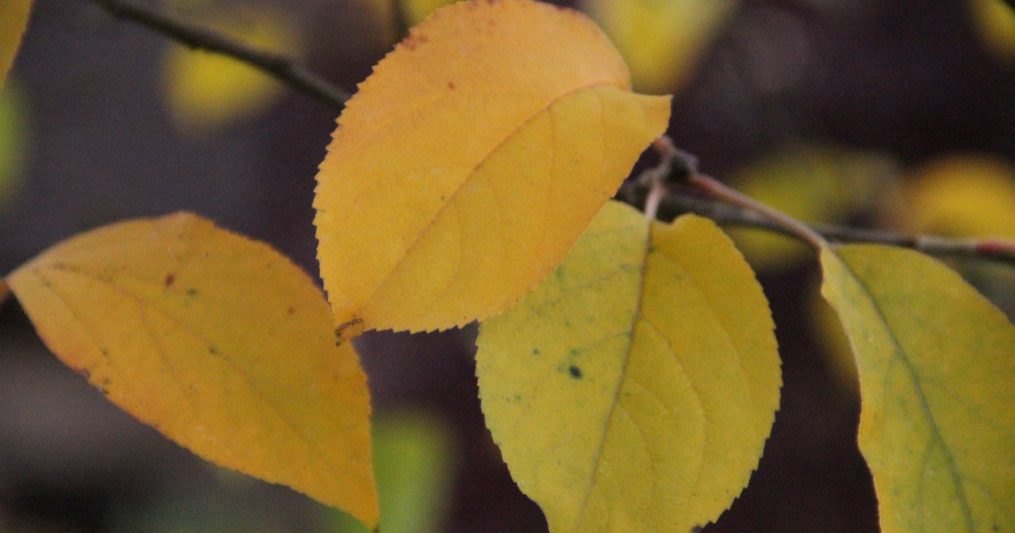
Common Milkweed

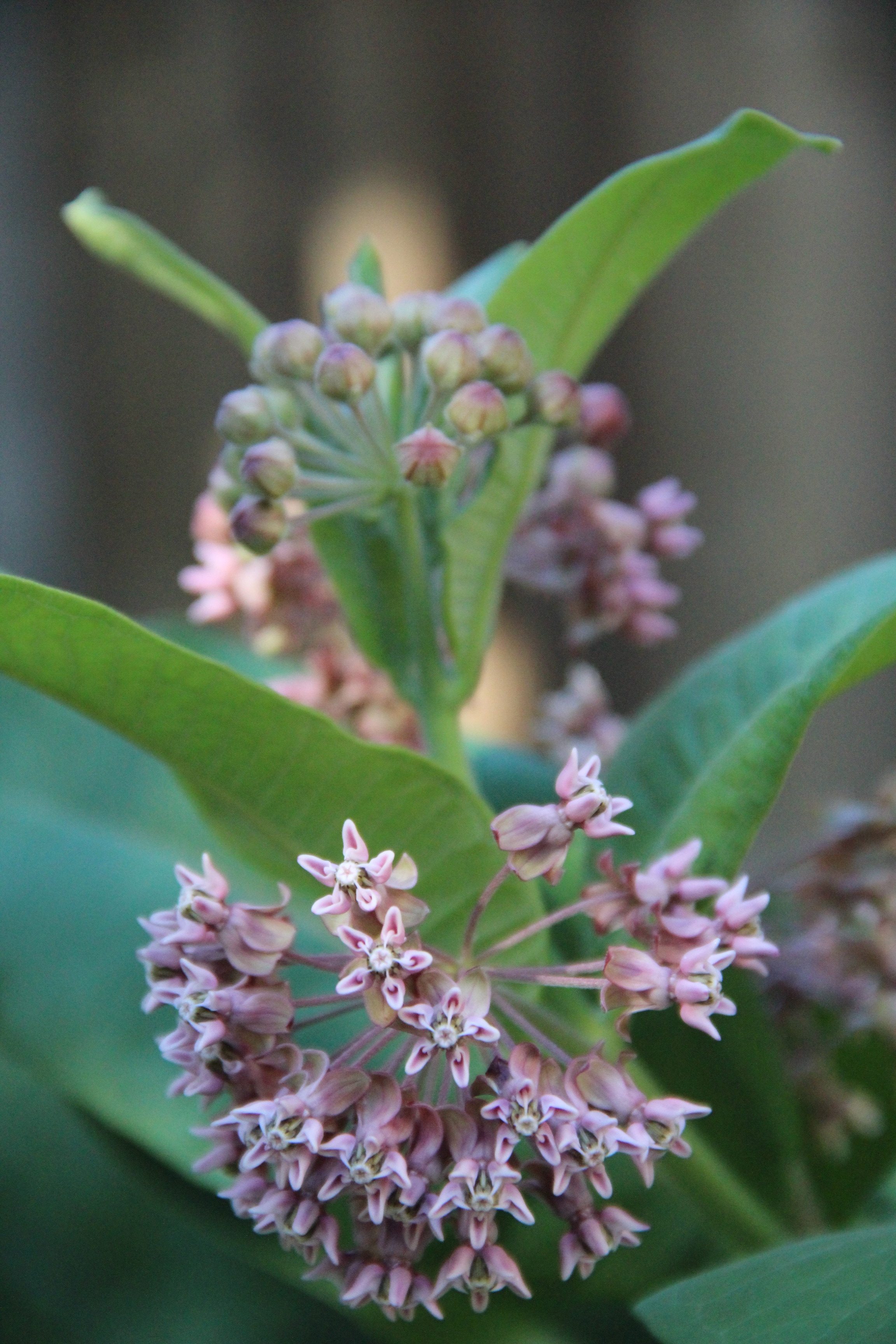
Monarch butterflies are rare this summer.  I’ve seen just one in our St. Paul, MN, garden, even as monarda, swamp milkweed, common milkweed, black-eyed Susan’s, Joe-Pye weed, phlox and a blend of other native plants and garden perennials bloom.  However, we have no shortage of milkweed to nurture monarch caterpillars if they were present.  A lush patch of common milkweed (Asclepia syriaca) grows in our yard, possibly the best-ever since I spotted the first plant shooting up in the middle of a juniper hedge 15 years ago.  The first milkweed blossom opened on July 7 and  most of the plants were flowering by July 17.

Image

Milkweed buds and blossom.

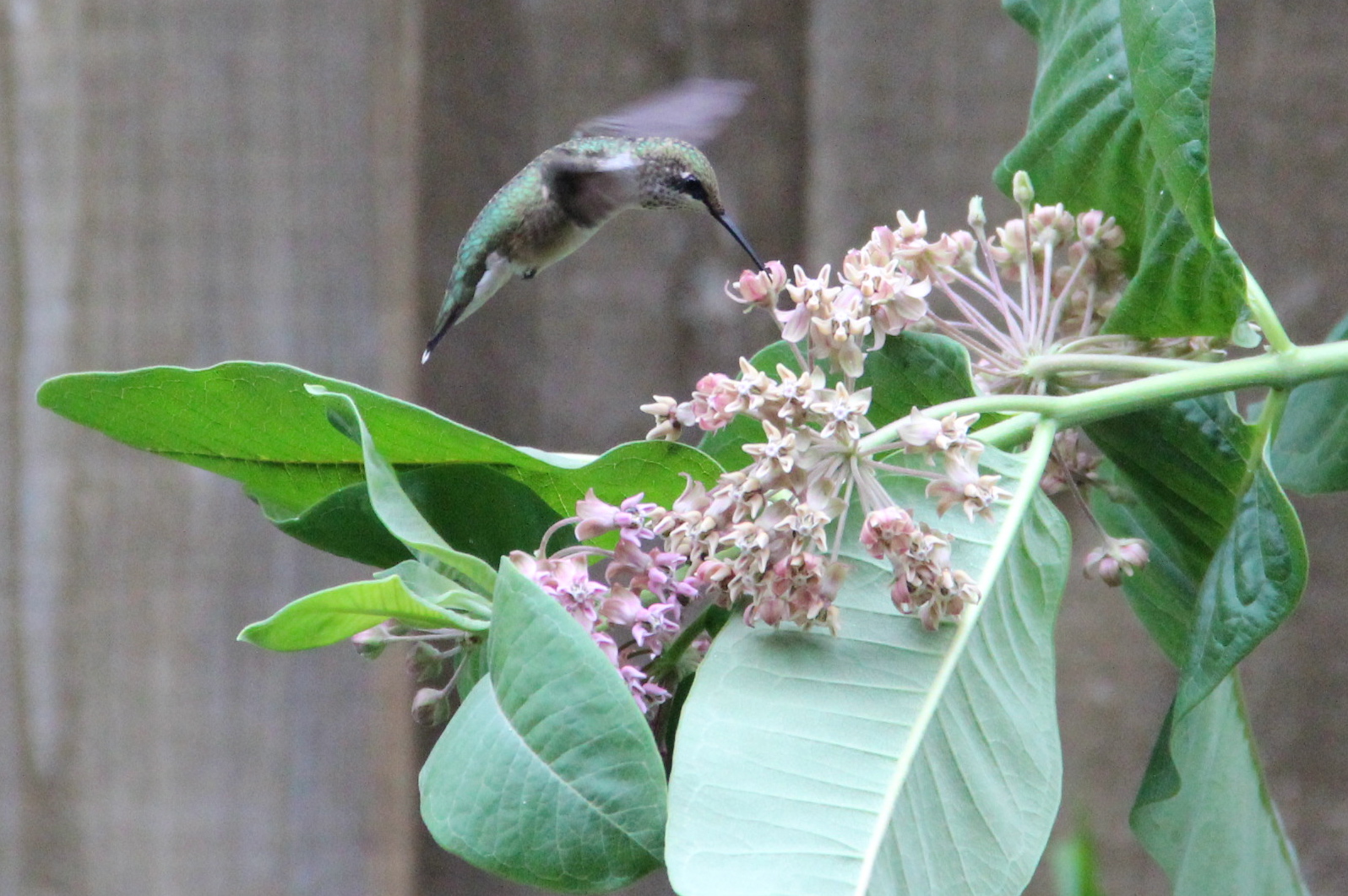
Though monarchs are absent, red milkweed beetles, bumble bees and ruby-throated hummingbirds frequent our patch.

Image

Red milkweed beetle on swamp milkweed.

Image

Ruby-throated hummingbird sips milkweed nectar.

On July 22, I noticed the first seed pods.  New pods continue to form and the earliest pods have plumped-up in the past week.

Image

Newly formed milkweed seed pods.